

When the initial emergency dies down and the media's focus moves to another point on the map, the work of municipal cooperation continues.
The Catalan Fund for Development Cooperation (FCCD) celebrates its 40th anniversary this year. For four decades, the organization has shown that solidarity does not end when the lights of the first emergency response go out. Faced with the increasingly frequent and intense impact of social and natural disasters, it is committed to a reconstruction model that goes far beyond immediate rescue.
We talk to its president , Jordi Cuadras , about how the climate crisis is transforming the response to disasters, what role Catalan city councils play in maintaining commitment over time and why true resilience comes from ensuring that local communities themselves lead their own future.
How does the Catalan Fund work in the event of an environmental disaster?
We always work on deep, medium and long-term projects. That's what we always say: we work more on the post-emergency than on the emergency or on immediate emergency campaigns.
What role does it assume when the first phase of the emergency ends and media attention disappears?
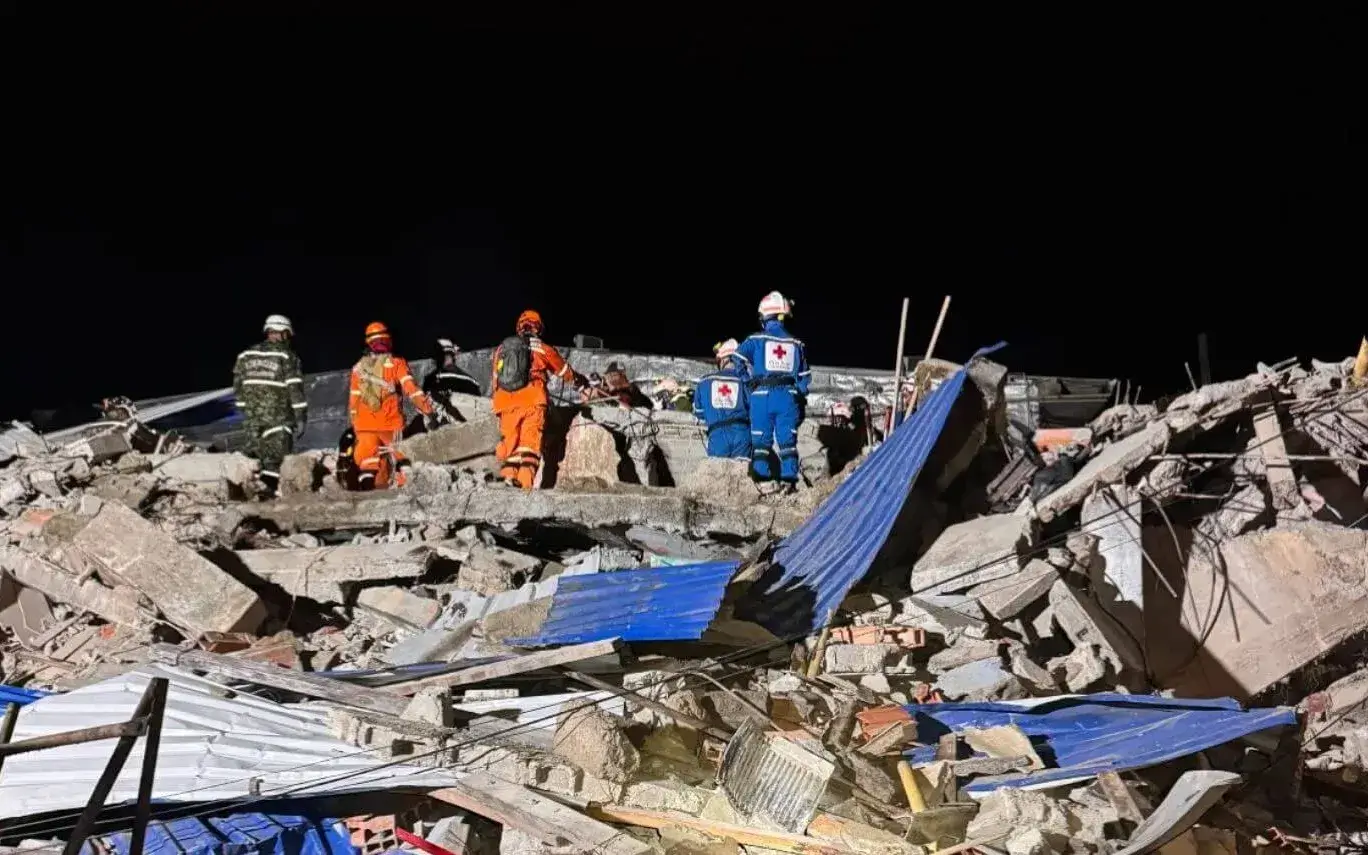
In the first phase of an emergency, what is needed is to save as many lives as possible, to rescue people who have been trapped (whether by a flood or an earthquake). In this first phase, we are not there because we do not have the technical teams to do this task. Then we enter the post-emergency: reconstruction projects and projects to guarantee the most basic things for the lives of those people who have been left homeless or have had to be displaced. We focus mainly on children and vulnerable women, who are always the groups that are most unprotected.
We do this whether there is a media outlet or not. For example, with the earthquake in Morocco we opened the emergency campaign and we have done between five and eight projects to care for the consequences and victims of the earthquake, and we develop all these projects during the three years that followed. When no one talks about them, we are working on deep projects that have a long journey in time.
How has the climate crisis changed the frequency and type of disasters you have to respond to?
The climate crisis is accelerating all these disasters and phenomena. However, the countries of the Global South, unfortunately due to their situation, are countries in which, long before there was talk of climate change, they were already suffering the consequences of these phenomena (floods, earthquakes, etc.).
Therefore, we may not have noticed a big difference in initial impact as we have in our country —where the phenomena have increased and have become less predictable and more serious—, but in the countries of the Global South, due to their atmospheric situation, these phenomena have been increasing for many years. From the point of view of the Catalan Fund, we have been campaigning mainly for floods and earthquakes for many years.
How do you ensure that it is the local communities affected themselves who lead their reconstruction?
For us, in any of the projects we do, this is an absolutely essential and key point. We always understand cooperation from a horizontal point of view, never from a vertical point of view. We do not give lessons to anyone or tell them how things should be done, but rather the projects come from a joint work between the receiving communities and the communities that allocate resources (the different municipalities that are partners of our entity).
We always work with what we call counterparts on the ground, who are local partners, whether they are local councils or NGOs. Our essence is municipal politics, we represent the councils of Catalonia and, when we go to countries in the Global South, our interlocutors are also always local agents (governments or entities). This allows us to carry out projects that are deeply rooted in the territory and to know practically by name the people we help to improve their living conditions. Incorporating a local perspective is the best guarantee that the project will meet its objectives.
What tools are applied to rebuild better and prevent the next disaster from causing the same damage?
Here we are talking about two phases: one is to respond to the immediate damage and the other is to try to ensure that this response also serves to prevent the same devastation from occurring again in the future. An example is the reconstruction of homes or schools that we are doing in the Atlas Mountains of Morocco.
Obviously, having suffered an earthquake makes the perspective different and there is a learning in the reconstruction to prevent that, if a phenomenon of these characteristics happens again (which cannot be predicted), the consequences are minor. The same thing happens with floods: we analyze how the flood occurred or which areas it affected, and the reconstruction incorporates this to prevent that the consequences are as less tragic as possible for people again. When they are tangible aspects such as infrastructure, prevention can be incorporated directly into the construction.
How do you ensure that recovery plans do not leave vulnerable groups behind?
When there is a disaster of this nature, the first to be left in a vulnerable situation are always children and women, two profiles that often already have vulnerability built into their daily lives in these countries where there is a much greater gender gap or where there are no basic social services.
In all our projects —as in the case of Ukraine, Gaza or Morocco— this perspective of protecting children and women is always incorporated ex officio. This can be psychosocial support for children who have just experienced a traumatic situation; it can be protection programs for women victims of gender-based violence (who in emergency situations are even more unprotected); or it can be guaranteeing their financial autonomy through cooperatives and cooperative work that empowers them in their communities.
What role do Catalan city councils play in maintaining support?
The Catalan Development Cooperation Fund was not created to respond to specific emergencies, but rather was created in 1986 —and this 2026 we celebrate its 40th anniversary— to carry out long-term transformative projects, which are not reactive but proactive. The more than 330 Catalan municipalities that are part of our entity (representing 85% of the population) do so because they believe in cooperation, development and solidarity as transformative tools.
Last year we managed 5.2 million euros for cooperation and solidarity policies, and this is the bulk of our activity: simultaneously promoting around fifty annual projects that have the planned support of the municipalities. Emergency campaigns receive exceptional funds, but they do not replace the funds that we, the municipalities, allocate year after year in a predictable manner to transform communities.
How are the constant environmental crises in the world being combated?
It is difficult, but before crises occur, a firm commitment from governments around the world is needed to take preventive actions. For example, by preventing deforestation and the taking of land from indigenous communities for the interests of large companies, or by preventing the contamination of aquifers by the installation of mines.
We act on the ground to combat these root crises: in the Lempa River (which crosses El Salvador, Guatemala and Honduras) we have a water regeneration project to ensure that communities have water for drinking and irrigation. Another case is in Senegal, in the Casamance River Delta: the rise in sea levels due to the climate crisis has salinized the delta and made fishing and rice cultivation impossible. Through Catalonia's experience with the Ebro Delta, we help introduce vegetation and resources to extract salt from the water and recover the population's economic and food activity.
How is climate justice and losses and damages addressed through municipal cooperation?
It is addressed by preventing local communities from losing their livelihoods and natural resources at the hands of large-scale exploitation or due to the effects of the climate crisis. For example, in Nicaragua we had a project to support food sovereignty in Puerto Cabezas that allowed the lands of local indigenous communities to be cultivated. There, it is considered that if a land is not cultivated, it does not belong to anyone and, therefore, many companies or external actors appropriated it. We guaranteed the tools for them to cultivate it and thus prevent it from being taken from them.
Climate justice from a municipal perspective involves defending the rights of the population over their own territory and giving them resilience tools.
How do you coordinate with other local and international actors?
In an emergency, coordination is absolutely basic and indispensable because it is a time when many people want to help and the clock is ticking. Resources must go where they are needed and cannot be lost or diverted along the way.
We coordinate with the Government of the Generalitat, the Catalan Cooperation Agency and the Spanish Cooperation Agency (AECID), as well as with all the local entities with which we already have a relationship. Coordination spaces are created to know which projects are being set up, which ones we can collaborate on and which ones we can develop ourselves. This network allows the trickle of exceptional resources that arrive during the media attention to quickly become real projects on the ground through our technical team in the area of emergencies and humanitarian action.
What learning from past projects has shaped your approach?
The main learning comes from the accumulated four decades of experience of the entity and the professionals who work there. Seeing how the world has changed, how the priorities of the countries have evolved and how the awareness of the town councils of Catalonia has grown positively (we were born with 6 town councils in 1986 and now we are more than 330).
This journey has led us to especially promote technical cooperation, a very valuable part of cooperation that fosters the exchange of experiences, knowledge and successful public policies between technicians from Catalan city councils and those from municipalities in the Global South. Constant learning shows us that, although inequalities continue to exist, municipal cooperation has a real capacity for transformation.
What can Catalan municipalities learn from the resilience of the Global South in the face of phenomena such as drought or fires?
This learning is absolutely total. The situations that we have seen for years in the countries of the Global South are now being reproduced in Catalonia: high temperatures, sudden changes in weather and alteration of climatic phenomena.
Based on the shared work we do with them, we can take advantage of their experience to address climate change in our country: in terms of crops, living conditions, the use of public space or the reorganization of working hours. In many countries in the Global South, working life begins at five in the morning because at certain times of the day you cannot work on the street due to the heat; it is a reality that, from what we have seen in recent summers, we will end up adapting here too.
What role should the associative network and citizens in Catalonia play in supporting these processes in the long term?
The associative network plays an absolutely key role. Behind the political commitment of the city councils there is a network of local entities and NGOs in each municipality of Catalonia that help to make the projects a reality with volunteerism and many hours of dedication. Catalonia has always had a solidarity fund and a historical empathy towards global injustices - such as the mobilization for the 0.7% in the nineties, which was the germ of the Catalan Fund.
Currently, there is a generational change challenge in many entities. That is why we defend that cooperation policies must be increasingly structural within the local public policy of a city council: if there are entities in the municipality, they must be accompanied, but if there are none, the institution must continue to guarantee this task. Allocating a small part of municipal resources does not harm the rest of local policies and, on the other hand, for the people who receive it in the Global South, it represents an enormous vital change.




Add new comment