
-
Image
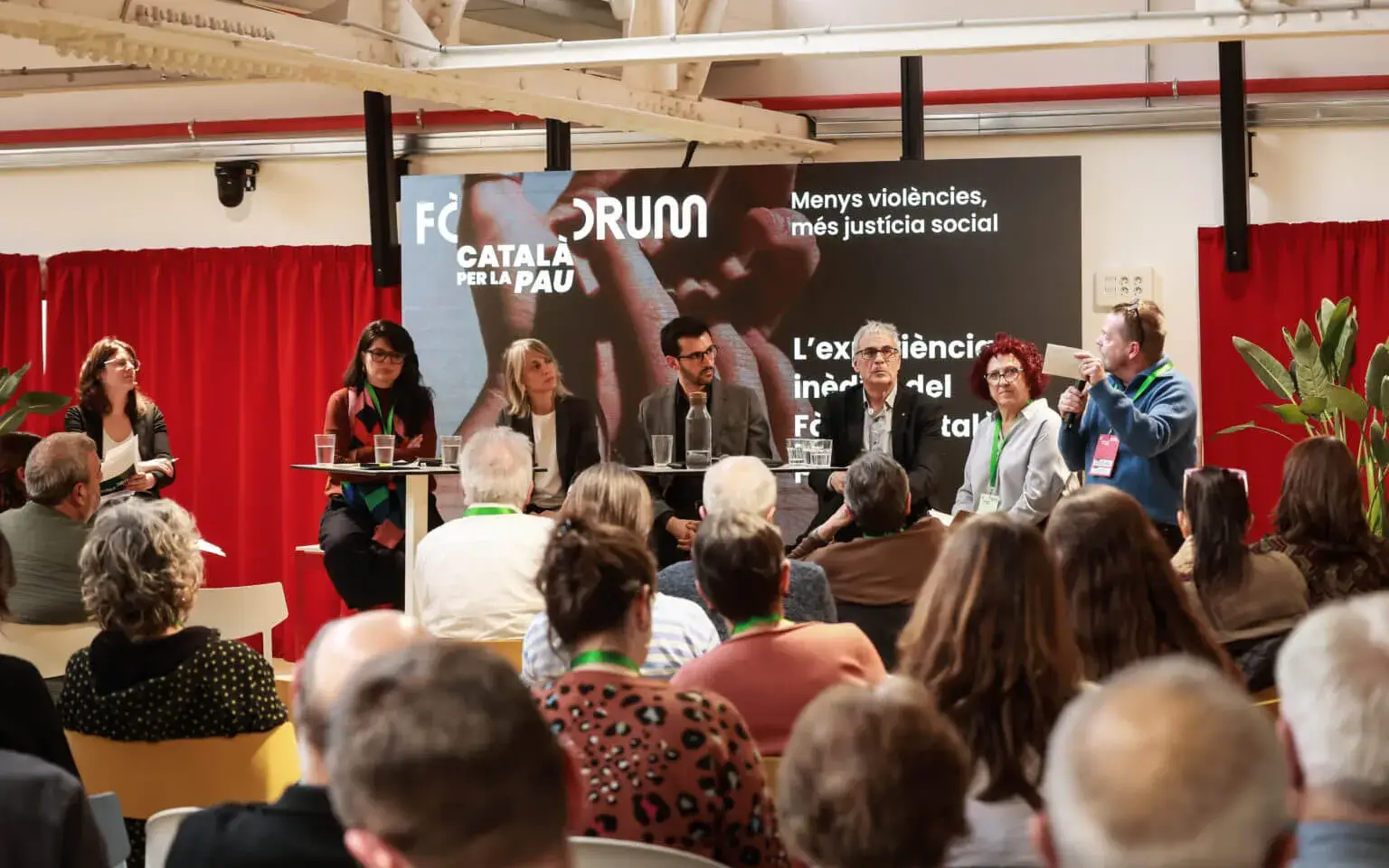
Source: Catalan Forum for Peace.
After two years of debate, the Forum’s participatory process has closed with 913 proposals on the table to shape the Country Director Plan for Peace.
When we talk about peace, we often reduce it to the absence of war. But if we look beyond, peace is not only at stake in distant conflicts —such as Palestine or Iran— but also closer to home, in our daily lives. A society that cannot guarantee decent housing for its citizens, that does not stop gender-based violence, or that tolerates police abuse can hardly be considered a peaceful society. That is why, if we broaden the focus, rather than the absence of war, we must understand peace as the absence of violences.
Within this framework, the first Catalan Forum for Peace has been launched, a participatory process of reflection and debate that has just concluded to shape the Country Director Plan for Peace, Catalonia’s first public peace policy.
Promoted by the Government of Catalonia, the Consell Català de Foment de la Pau, and the International Catalan Institute for Peace (ICIP), with the active participation of the associative fabric, the Forum pursues a dual objective: to develop a Country Director Plan for Peace and to strengthen the peace movement in the country. The process, which began in 2024 and closed in February 2026, must now culminate in this Plan.
An institutional gap and an opportunity to reconnect
If we go back to its origins, the initiative arises from a dual need. From an institutional perspective, there is no doubt that Catalonia has a long tradition in promoting peace. As a result of this momentum, in 2003 the Parliament approved the Law for the Promotion of Peace, which commits Catalan institutions to work for peace both abroad and at home. That framework opened the door to the creation of specific structures, such as the Consell Català de Foment de la Pau or the ICIP, which today are driving forces behind the Forum.
However, as explained by Kristian Herbolzheimer, director of ICIP, a gap was identified in this regard: “As a result of many shared reflections, we detected that a peace policy from the Government was missing, and that without this framework it was difficult for these institutions to ensure a peace policy. This was conveyed to the executive, which took it on and committed to building a peace policy through a participatory process, which has ultimately crystallized in the Catalan Forum for Peace.”
On the other hand, the initiative also stems from the need of the associative movement to reconnect after several years of disconnection marked by the pandemic. Josep Maria Royo, researcher at the Escola de Cultura de Pau and member of Lafede, states that it was about “finding a space for reflection and reconnection among organizations.”
The momentum coincided with the twentieth anniversary of the Law for the Promotion of Peace, which served to reactivate conversations and, above all, to broaden alliances with other movements —for climate, anti-racist, or feminist causes— that have not always been considered part of the traditional peace movement. “We needed to update ourselves, rejuvenate, and build stronger networks,” summarizes the representative of the social organizations promoting the Forum.
Peace, also from an internal perspective
This convergence —the institutional gap of a public peace policy and the need of the associative movement to reactivate alliances and expand the map— is the driving force that sets the Forum in motion with the aim of building Catalonia’s first public peace policy. This policy aims to go beyond development cooperation: “In some issues it overlaps with peace policy, but not entirely, and it shifts the focus from only looking at what happens in the Global South to also looking at what happens at home,” says Royo.
If we delve into this distinction, Royo explains that cooperation and education for global justice have mainly served to raise awareness about the causes of poverty, wars, and human rights violations around the world, especially in the Global South.
In contrast, the public peace policy that the Forum seeks to promote aims to broaden the focus and assume that building peace is not only about looking at what is happening in Gaza or Congo, but also about asking ourselves what is happening in Catalonia in terms of human rights, education, racism, or hate speech. “Peacebuilding must not only be pursued in the Global South, but also in Catalonia,” he notes.
A debate built from the ground up
Based on this logic, the Forum has not been limited to a declaration of principles, but has been structured as a participatory process with deliberative sessions throughout the territory, self-managed meetings organized by entities and collectives, and online contributions.
This has resulted in a total of 913 proposals, formulated by more than five hundred people and around one hundred organizations, which have taken shape through some fifty working sessions and have been structured around five axes: culture of peace; security and justice; conflicts, violence and peace; global threats; and women, peace and security.
“We are talking about the most widely participated participatory process of all those promoted by any government of Catalonia,” Royo emphasizes. For Herbolzheimer, one of the keys to the success of the process is that it has not only been regulated, with sessions convened by the Council, but has also generated a wide range of self-managed spaces that have been deeply involved in the process with a multitude of concrete proposals. “This speaks very well of the awareness and organizational capacity of the country,” he states.
What does a peaceful Catalonia mean?
Based on this pool of ideas, the challenge now is to turn this broad participation into a public and applicable policy. Before that, however, it is necessary to clearly define the answer to one of the key questions the Forum seeks to address: What do we understand by a peaceful Catalonia?
Herbolzheimer argues that the Catalan singularity lies in the fact that the legal framework understands peace also as a task within the country, and not only as external action or solidarity with distant conflicts. In the participatory process, this perspective has been reflected in many contributions pointing toward social cohesion, coexistence, and constructive conflict management. In other words: talking about peace is also talking about how everyday conflicts are resolved, such as the protection of basic rights or access to housing, among others.
Along the same lines, Royo insists that the major shift is understanding that violence neither begins nor ends with war, and he provides examples that are part of daily life such as “the lack of housing, the abuse of authority by security forces in certain situations, the gentrification affecting our neighborhoods, or the proliferation of hate speech.”
A peace policy translated into concrete measures
For this reason, he defends the need to articulate a transversal, structured, and coherent public peace policy, both from an internal and external perspective, that avoids inconsistencies. “It makes no sense that, on the one hand, the Government or the Parliament speak out against the war in Gaza and, at the same time, the same Government is acquiring products manufactured under human rights violations,” he cites as an example. In this sense, promoting ethical public procurement criteria would be a first concrete step.
Looking more closely at the proposals, Royo offers further examples that clearly illustrate what a public peace policy means in practice. In addition to ethical public procurement, there is, for example, the proposal that public funds should not be linked to the arms industry, or that administrations should avoid working with banking entities that finance such activities.
He also advocates strengthening mediation and restorative justice tools as the main means of managing conflicts, instead of automatically resorting to punitive responses. He also identifies as priorities the prevention of gender-based and xenophobic violence, as well as the need for coherence in democratic memory policies, so that the institutional narrative and what remains in the streets do not diverge.
All this work, adds the ECP researcher, is not necessarily a matter of resources: “We are not talking about money, that is not the point, but about focusing on coherence and aligning what the Generalitat, municipalities, and schools do under the same framework of public peace policy,” he explains.
From a pool of ideas to the Director Plan
From here, the challenge now is to turn these more than nine hundred proposals into a tangible and applicable public policy. First, the collected material must be organized and transformed into the Country Director Plan for Peace. As planned, ICIP must draft an initial document based on the Forum’s pool of ideas; the Government must review it and take ownership of it; the Consell Català de Foment de la Pau must issue its opinion; and, finally, the Parliament must vote on and approve it.
This involves selecting proposals, distinguishing those that are applicable from those that fall outside competencies or are too generic, and translating them into “feasible, implementable, and measurable” measures, Royo points out.
At this stage, Herbolzheimer warns that the Director Plan for Peace will only be effective if it becomes a policy embraced by the entire Government and capable of influencing what departments such as Interior, Education, or Social Rights do, as well as the local level.
Without real transversal implementation and without the capacity to explain to citizens why this is relevant in a time of polarization, the Plan risks remaining a declaration of intentions that is more rhetorical than effective. “The challenge is to ensure that the commitment made by the Government of Catalonia to promote this plan becomes a reality,” concludes Royo.



Add new comment