
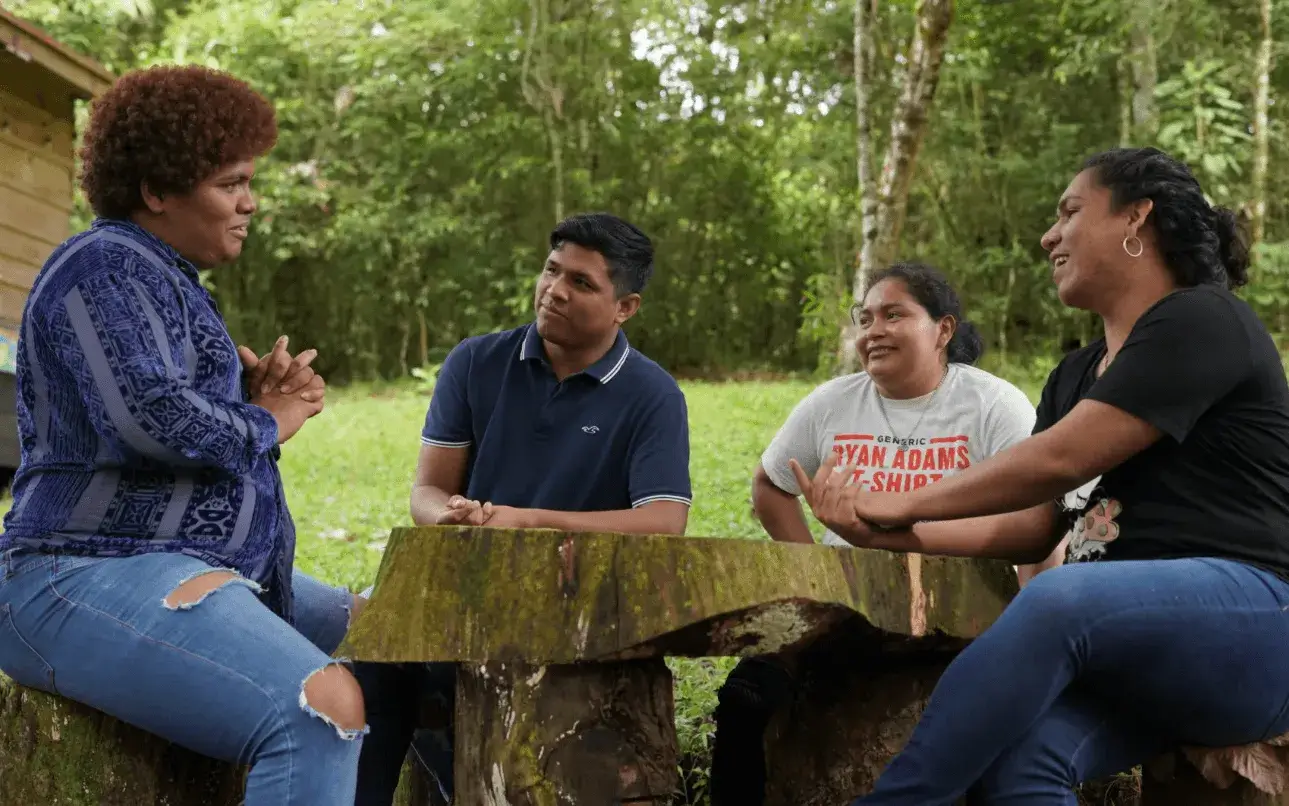
ACPP and ACATHI promote this documentary, directed by Adrián Silvestre, which portrays the lives of four young LGBTI people forcibly displaced to Central America.
In a small hostel in Guatemala City , four young LGBTI people try to rebuild their lives after being expelled from their countries of origin and deported in their attempt to reach the United States. Between fear, violence and hope, this space of transit becomes a place of belonging. This is the story told by ' Cobijo ', the new documentary by Valencian director Adrián Silvestre , which has arrived in Barcelona this May as part of the DocsBarcelona festival .
The film is part of the international cooperation project ' We fight for the rights of LGTBIQ+ people in Catalonia and Central America' , promoted by the Assembly for Cooperation for Peace (ACPP) and ACATHI , which combines research, awareness-raising and social action to highlight the structural violence faced by the group in countries such as Guatemala, Honduras and El Salvador.
For Eliana Eskenazi , ACPP delegate in Catalonia , 'Cobijo' sheds light on realities that are often left out of the public narrative. “This story represents the lives of people who cannot be who they are, who cannot show their gender or sexual identity to their family or community and have to leave,” she explains. “In this process of fleeing and seeking a dignified life, many die. And in this momentary pause, in this refuge, they can create bonds and support each other.”
Eskenazi stresses that there is still a lack of awareness about the magnitude of this violence: "We don't know what happens to people who are refugees because of their gender or sexual identity. Our role is to provide support and advocate so that they can live with dignity."
A documentary born from research and support
Director Adrián Silvestre explains that 'Cobijo' emerged from a joint proposal by ACPP and ACATHI. “They wanted a project that reflected the realities of the LGTBI community in Central America and the conflicts they face,” he recalls. “This became a very extensive investigation until we found a shelter in Guatemala that exclusively hosted deported LGTBI migrants or those who had not reached their final destination.”
From that fieldwork, an intimate story centered on four protagonists was born. “They traveled practically the entire continent with the desire to reach the United States,” explains Silvestre. “When I met them, the backpack they were carrying was tremendous: extortion, threats, abuse, violence . They arrived exhausted, in a very limiting physical and mental situation.”
But 'Cobijo' also shows the moment when everything begins to change. “The film tells the story of when they receive shelter, when they find like-minded people with whom to talk freely , a place to sleep and eat, and where they can start thinking about the future,” says the director.
From a public policy perspective, the documentary is also seen as a key tool. Gerard Graells , director of the Catalan Agency for Development Cooperation, highlights the importance of projects like this, stating that “ audiovisual is a transformative tool that can disseminate human rights and explain realities that we find in the Global South. It allows us to convey a story in a direct, impactful and visual way.”
As he explains, this perspective is essential to connect international cooperation with global education and awareness-raising . “It helps us explain the situations we face every day in our interventions and provide a transformative perspective on global challenges.”
A violence that is not far away
For Rodrigo Araneda , president of ACATHI , 'Cobijo' is a key piece to understanding the migratory routes and violence experienced by LGBTI people in Central America. "The project aims to delve deeper into the realities of refugees who escape Central America and who often cannot find a safe place anywhere," he explains.
Araneda recalls that these stories are not foreign to Catalonia . "When one migration route closes, others open. It's not something distant: in Barcelona we receive people from Central America seeking asylum . It's much closer than we think."
'Cobijo' has landed in Barcelona with the aim of opening spaces for reflection on the violence experienced by LGBTI migrants and refugees, and on the need to create spaces of protection and rights. The 'film' has been screened these days in the Docs&Cat section of the festival, with sessions that will include a subsequent debate.
Beyond cinema, the documentary is part of a cooperation program that aims to transform narratives, generate awareness and contribute to the defense of human rights in contexts of violence and displacement.


Add new comment