
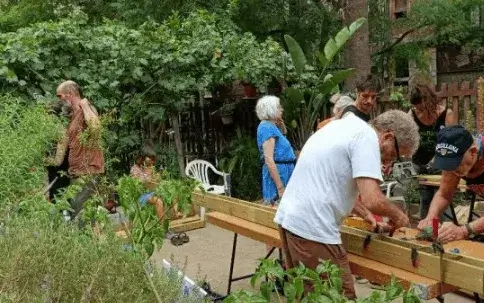
Given the climate emergency situation we are going through, and in the local/global context of urban population growth, it is urgent to seek solutions that mitigate the impacts of climate change on people's lives.
Founding member of Col·lectiu Punt 6, a work cooperative specializing in feminist urban planning.
We live in cities that have been planned with our backs to nature. Capitalist and patriarchal urbanism has prioritized certain productive, consumer and predatory activities of people and territories, ignoring the crisis of care that transcends time and space, especially for women. We are the low-income, migrant, racialized and indigenous women who experience the consequences of climate change disproportionately. These groups are more vulnerable to the effects of climate change because we have less access to land, resources, less institutional support and a lack of representation and participation in decision-making.
Despite the disproportionate consequences, an intersectional feminist perspective has not been incorporated into climate change mitigation strategies that incorporate women and vulnerable populations as agents of change.
In recent years, some cities have begun to develop networks of climate shelters as a strategy for adapting to climate change, mainly during periods of extreme heat or cold. Many of these initiatives have been promoted by public institutions and city councils, without including community initiatives that could be or already are climate shelters. On the one hand, these climate shelters do not have a community vision, ignoring the diverse needs of the community. On the other hand, green and blue spaces have been increased without considering the consequences of unequal distribution in neighborhoods, contributing to green gentrification.
In response to this utilitarian and institutional approach, from Col·lectiu Punt 6 in the last 5 years we have accompanied the creation of networks of community climate shelters and care, incorporating an intersectional ecofeminist perspective.
A community and care climate shelter is any space that generates thermal comfort in the face of heat or cold waves, rain and/or extreme climatic periods. These spaces can be green infrastructures, such as parks and gardens, air-conditioned centers that provide thermal comfort in situations of extreme heat and cold, and emergency shelters for episodes of storms, floods and forest fires. They can be existing spaces or they can be newly created spaces, but in both cases they must make the function of climate shelter compatible with other uses and functions.
In order to integrate a feminist perspective, climate shelters must be accessible spaces designed to meet the needs and desires of neighbors who know their community and its inhabitants, as well as to facilitate connection with nature and between people and where they can not only take refuge from the heat, rain or other climatic event, but also share attention, hold meetings or festive activities and interact with the rest of the community. Therefore, they must be green, safe, accessible, community, feminist spaces and where neighbors are not only the passive subjects who use them, but also those who design them and fill them with life.
Climate shelters have the potential for positive impact at an ecological level to mitigate and adapt to the impact on people of severe climate episodes and also socially, as spaces for community organization. It is essential to make visible that they must also respond to community and collective management of care. Climate shelters must go beyond the climate component and advance to be a space for care and community organization, free from sexist, racist, ableist and LGBTQ+ violence. For this reason, it is essential that climate shelters are intertwined with a community network of care.
In Barcelona, we have worked in our neighborhood, on the Construction of the Climate Trench of the Old Town, a community project developed together with Luciferases, the Caixa d'Eines i Feines and the Federation of Community Management Entities of the Casal of the Pou de la Figuera neighborhood. For two years, we have had community conversations about what climate change is and how it impacts the neighborhood, we have identified community spaces that already function as climate shelters, such as the Hort del Forat or the Plaça del Pou de la Figuera, and we have expanded the climate trench with improvements in some of the spaces and making visible the network of community and care spaces that make up the trench and incorporating the feminist and class perspective.
For more information, www.trinxeraclimatica.org


Add new comment