
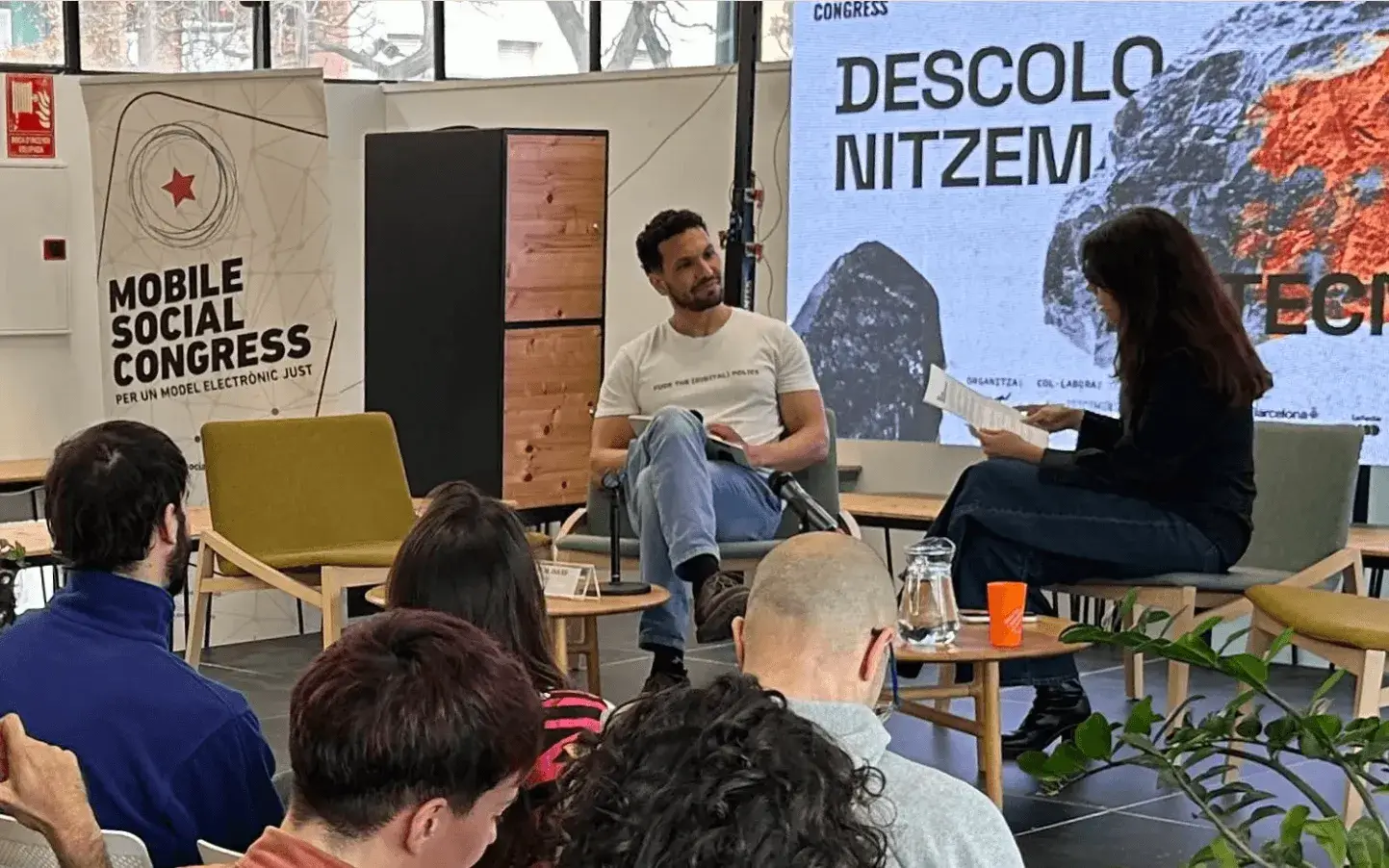
The AlgoRace collective warns that AI reproduces racial inequalities and that it is necessary to "combat racism to transform technology."
The last edition of the Mobile Social Congress , the ethical alternative to the Mobile World Congress, promoted by Setem , was held in Barcelona . As part of the roundtable discussion, the AlgoRace collective participated in the presentation ' How do we make an anti-racist, decolonial and feminist AI? ' held at the Canòdrom in Barcelona.
Youssef M. Ouled , journalist and coordinator of AlgoRace, began his speech with a clear warning: “ AI systems reproduce racial inequalities .” Ouled has been studying for more than five years how technology , far from being neutral, amplifies the colonial and discriminatory logics that already operate in institutions. “We research how AI systems reproduce racial inequalities,” he explained, “and we try to make our work produce some change at the political, legislative and institutional levels.”
AlgoRace is a team made up of people from the anti-racist movement, feminism and academia . Their work revolves around three axes — research , awareness-raising and political advocacy — which have led them to a clear conclusion: technological racism operates on two levels. “On the one hand, there is a more individual level , where people design, think about and implement these technologies, and this causes biases of race, gender or class to be transferred .” But, on the other hand, there is a much deeper structural dimension , according to Ouled, who added that “if you implement border technologies that seek to limit human mobility, there is no bias here: there is a political , racist, colonial decision .”
During the presentation, the journalist and coordinator of AlgoRace reviewed the areas where these systems are already operating : borders , police , justice and, even, the fight against gender violence . In fact, in their latest report on VioGén , the comprehensive system for monitoring cases of gender violence that has been applied in Spain since 2007, they warn that these tools “are presented as magical solutions to structural problems” but that, in reality, “ they unprotect migrant women and criminalize racialized men ”. The lack of transparency is another of the major obstacles, as explained by AlgoRace. “A woman who reports gender violence does not know that a scale of risks is being applied to her. There is no information. And when we do not have information, we cannot assert our rights”.
For this reason, the collective insists that the fight is not only technological, but also political . “No matter how much you fight for a technology to be less racist, if you have a racist system it will continue to produce racist technology for you.” The answer lies in organizing, and this is where the 'Grupo Semilla' comes into play, a space for anti-racist collectives that promotes workshops , campaigns and joint actions and, from where Ouled commented, "they are trying to promote real change."
AlgoRace's presentation left a final message that resonates strongly: technology cannot be fixed without transforming the society that produces it . "It's not just about correcting algorithms, but questioning the structures that feed them," insisted Ouled.
At a time when AI is expanding into all areas of life, the Mobile Social Congress reminds us that technology is neither inevitable nor neutral and that decolonizing it is a collective, slow and essential process.
An alternative congress to decolonize technology
AlgoRace's intervention was part of a Mobile Social Congress that, this year, had as its motto ' Let's decolonize technology '. As Clàudia Bosch , a technician at Setem and part of the organization, explains, this edition is "more relevant than ever" , at a time when "big technology companies seem not to be in favor of protecting humans and users".
The congress aims to analyze “the social and environmental impacts” of the current technological model and denounce “how colonialism continues to prevail in global technology chains.” Decolonizing, says Bosch, is a “corrective, present and ongoing” process that involves reviewing how technology is designed , marketed and used , and above all, “who loses in this model.”
This year's program included talks on the impact of AI on the reproduction of social biases , the role of large technology companies in global agriculture , the growth of macro data centers and community resistance to extractivism . Defenders of territories from the Democratic Republic of Congo , Guatemala and Mexico also participated , sharing their strategies for standing up to mining operations. In addition, as usual, the congress also dedicated a day to free software through the Dolibarr Day of SomNúvol.





Add new comment