
The project, developed by ADFO and the UPC, facilitates rehabilitation for people with chronic needs through an accessible and motivating virtual reality tool.
“We work the whole body, balance and cognitive attention; and we do it through games that motivate you to do it — otherwise it would be very boring,” explains Jacint Llastanós, a user of the Associació de persones amb Discapacitat Física d’Osona (ADFO) who is recovering from a stroke, in a report by El 9TV.
Jacint, like other users and professionals from the Osona-based organization, has helped create Muvity, a project developed in collaboration with the Universitat Politècnica de Catalunya (UPC) that puts innovative technology such as virtual reality at the service of improving the quality of life of people who need physical rehabilitation.
Today, around 13 million people worldwide are affected by stroke and, in Spain alone, nearly 120,000 cases are diagnosed each year. Beyond the acute phase, many of these people require physical rehabilitation throughout their lives and, if treatment is not personalized and consistent, they may lose mobility and autonomy over time.
But the public healthcare system is saturated and cannot always offer the necessary frequency of sessions. In this context, Muvity proposes an alternative to turn exercises into a sustainable routine, from home and with greater motivation. We spoke with Marc Marot, one of the project leaders, to understand how the platform works, how it adapts to each user and where it currently stands.
How would you explain what Muvity is to someone who knows nothing about it?
Muvity is a game-based rehabilitation system that allows physiotherapy sessions to be carried out from home, without the need for a physiotherapist to be physically present. It can also be used in nursing homes and in clinical or social organizations. It is particularly valued because it makes it easier to carry out rehabilitation outside the physiotherapist’s schedule and because it responds to people with chronic or permanent needs, who require daily or very frequent consistency throughout their lives, not just temporary intervention.
What need did you identify to launch the project?
The need arose from seeing that many people with conditions such as stroke or ALS require constant and permanent rehabilitation, with no defined endpoint in the recovery process. If they do not maintain this consistency, they may gradually lose mobility over their lives. However, the public system and insurance companies usually cover the acute phases and, once the situation stabilizes, many people are left unsupported at home. Turning to private physiotherapy on an ongoing basis is very expensive, and the availability of physiotherapists is also limited. In this context, and from the collaboration between ADFO and the UPC, Muvity was born.
How does the tool work?
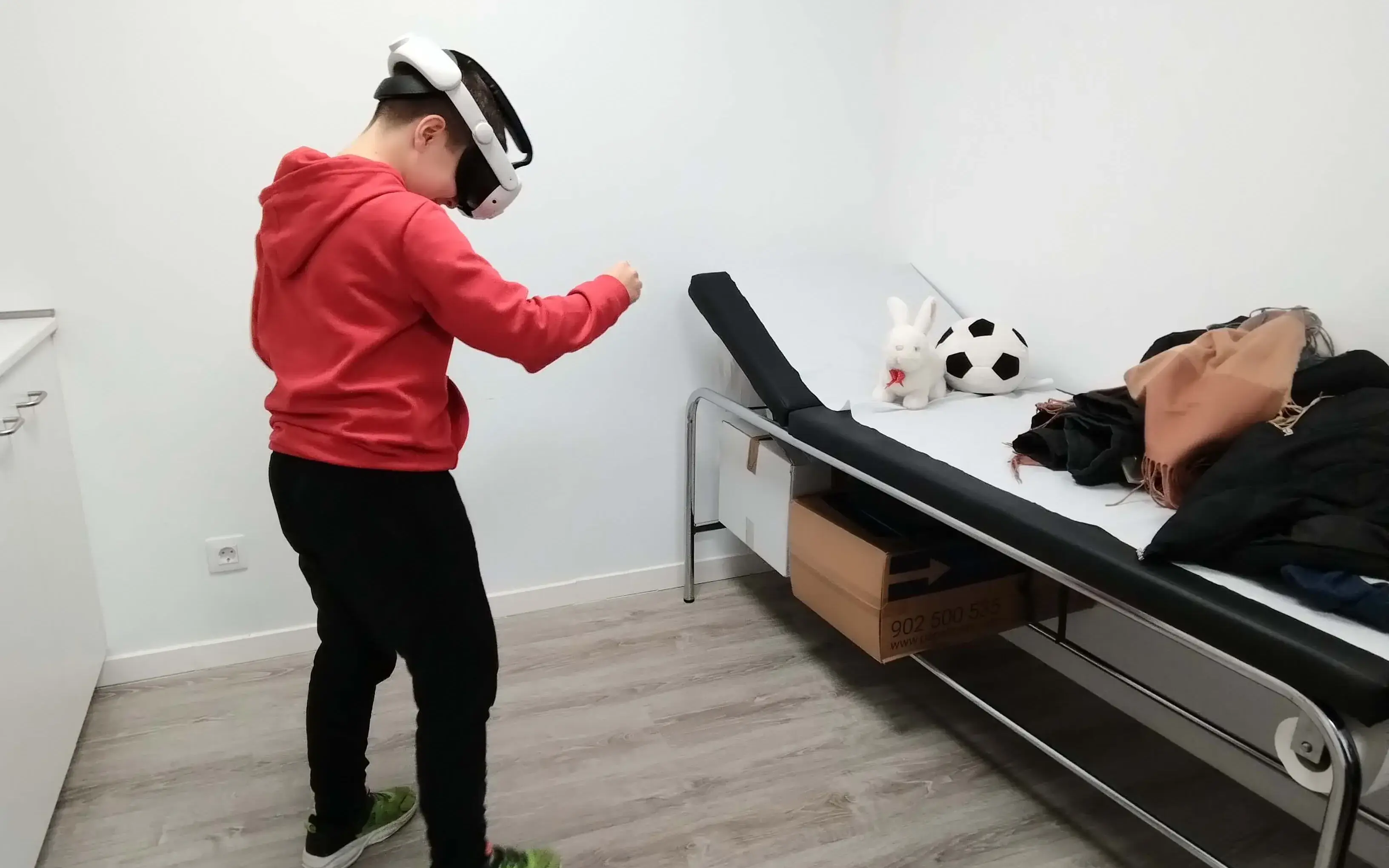
It works in a very simple way. With a conventional computer, like the one we might have at home or in any organization, a commercial depth camera is connected and our software is installed, like any other program. From there, the health professional inputs the exercises as if they were homework, so the user already has them assigned. When they open the computer, they just have to press Play, stand in front of the camera and the screen, and through their body movements the platform guides them to encourage specific movements. The camera captures these movements and interacts with the screen, in an environment designed like an interactive video game, but with a therapeutic rather than recreational purpose.
So it adapts to each patient’s needs.
Yes, each exercise is personalized according to the user’s needs, and it is the health professional who determines what each person must do. In addition, the first time the user enters the platform they are asked to calibrate it to identify their maximum movement limits. This allows the objectives to be adapted to what they can actually do. For example, if a person with stroke, spasticity or hemiplegia cannot raise an arm above shoulder height, the system adjusts the challenge so that it does not ask them to go beyond that limit.
Why did you design it as a game?
The team behind it comes from the video game world and we have applied that knowledge to a digital tool. This allows us to spark as much interest as possible in the user and maintain their focus and concentration while performing the movements we want to work on. In the end, what we are looking for is adherence: when people are prescribed exercises at home, such as lifting a bottle and doing abductions, they do it for a couple of days, but it’s boring, it’s not guided, and they don’t know if they are doing it correctly, so they end up giving up. With Muvity, on the other hand, they enjoy it and it’s as if they were playing a video game.
Technology is often a barrier for many people. How did you make Muvity accessible to everyone?
At first, we thought technology would be a significant barrier, especially for older people. But we were surprised to see that, in many cases, people in their eighties are the most motivated to use it. For many, it’s the first time they play a video game, and that opens up a new world that encourages them even more. They may need some help at the beginning, to turn on the computer and start the program, but once that’s done they understand it well. Obviously, it’s not a valid tool for everyone, especially when there is severe cognitive impairment, which is where the greatest limitations lie.
Here, ADFO’s role has been fundamental.
Yes, involving ADFO users in developing the tool from day one has allowed us to make it accessible. Week after week we put them in front of the screen, without explaining anything, to see what they understood, what didn’t work and where they got lost. Through this constant trial-and-error process, we eliminated what didn’t work and improved what did, until we achieved a tool that we know is accessible and useful for the people who have to use it.
Creating a tool like this required a team with very diverse profiles.
It has been a sum of efforts, because Muvity is a shared project. The UPC contributed the technology, with doctoral students and professors involved in making the tool useful, and at the same time we worked side by side with ADFO users. Profiles like mine and my colleagues — video game developers — were also incorporated, along with physiotherapists, especially to define the exercises that could be done from home. From there, the work was collaborative: brainstorming sessions to decide which activities were most appropriate, what type of game best suited the movements we wanted to encourage, and how to measure them. In short, a very diverse team to bring together different perspectives and make it possible.
What feedback have users given?
Overall, the feedback has been very positive. Ninety percent of the people who try it end up saying they like it and enjoy using it. As I mentioned, for many older people it is their first contact with a video game, and they find it fun and motivating. Moreover, in the clinical trials we have conducted so far, what we see is that people who use Muvity are much more motivated than those doing conventional exercises facing the wall, so to speak. In this sense, users seem happy with the tool.
Where does the project stand now?
At the moment, the tool has been developed thanks to grants and calls obtained through social departments and also linked to the university, such as the UPC. The joint efforts between ADFO and the UPC have made it possible to hire staff, but this funding eventually runs out and we must find a way to maintain the project.
What is the next step?
We are talking with the Catalan Government to see whether they want to continue supporting the tool. And to prevent it from coming to a halt, we are launching a spin-off in the form of a limited company in order to commercialize it and offer it to social organizations. The key is to make it sustainable and guarantee its maintenance: it’s not about getting rich, but about preventing the project from ending up in a drawer now that it has been developed, and allowing many more people to benefit from it.
Does the project have the potential to expand its reach?
Yes. Although the tool was developed mainly focused on stroke — because each case is different and it is difficult to create a single platform that serves such diverse realities, and stroke has therefore been the reference for clinical trials — the project has room to expand into other areas. For example, ageing without an underlying pathology is a simpler scenario and, if it works for stroke, we understand that it can also work here.
Are you moving in that direction?
Yes, in parallel, we have partnered with Dincat, in the field of intellectual disability, and with ECOM, in physical disability. Right now, it is being tested with around 25 of their organizations and also in nursing homes, to see how far the application can go and in which cases it can be useful and in which it cannot. Today, about 25 organizations already have it and are testing it to assess whether there may be interest in the platform.




Add new comment