A format that democratizes content creation, gives voice to communities and promotes narratives that often remain outside of traditional media.

Association dedicated to the creation of feminist digital content, in Catalan and with a young perspective.
In recent years, we have seen how the podcast has become one of the most popular communication formats, both in the major media and in smaller, self-managed groups and entities, becoming a powerful and transformative tool for social organizations that want to generate their own discourse. And all this, going against the grain. In a digital ecosystem where immediacy and visual saturation predominate, the podcast has managed to reclaim a central space for voice, narrative and own discourses.
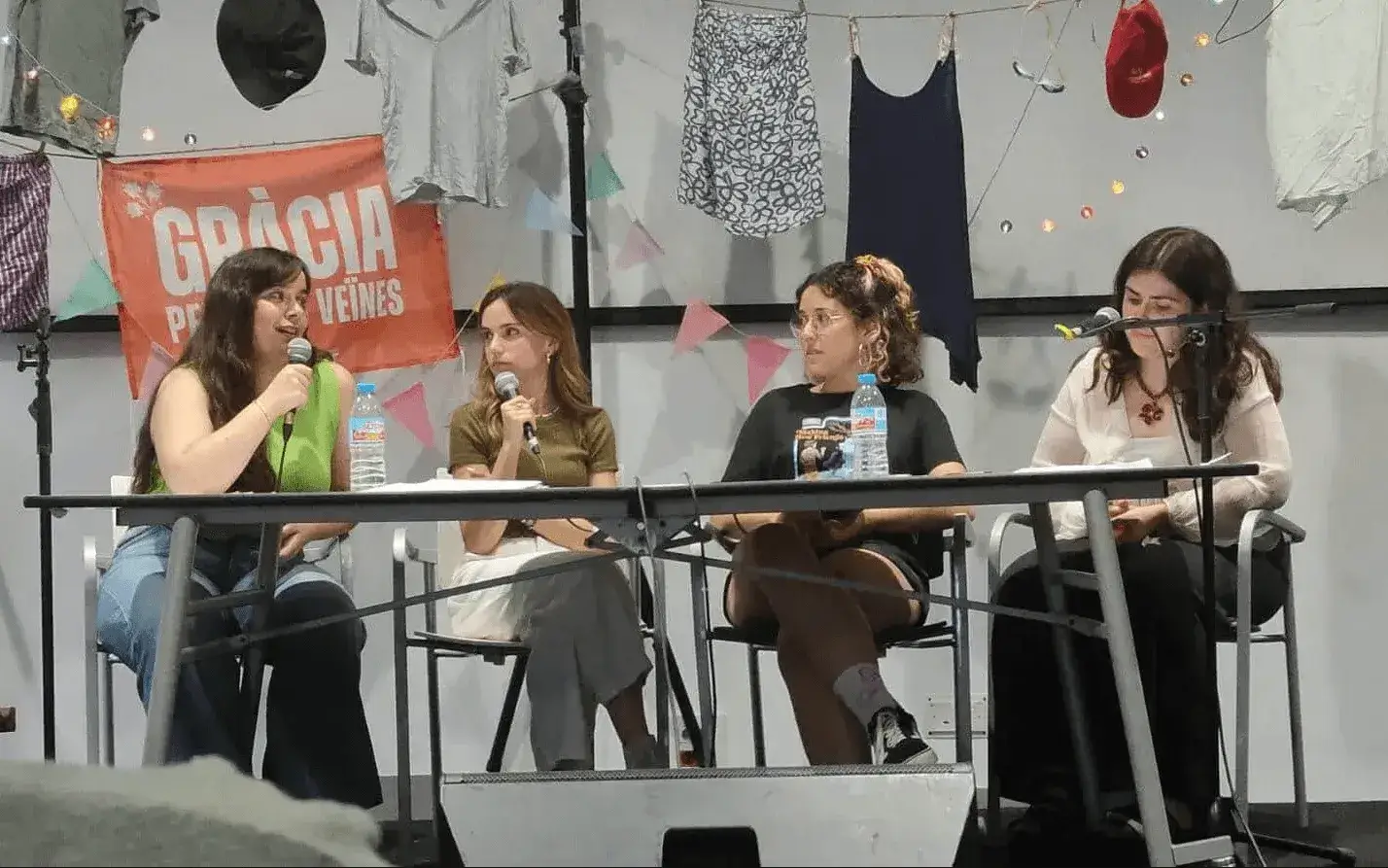
The podcast allows us to tell stories calmly, share experiences in depth and build narratives that often do not find a place in traditional media. At Onada Feminista, where we have been creating feminist digital content in Catalan for seven years, we have seen how this format democratizes content creation and opens the door to narratives that were previously out of focus. And it does so through the voices of the protagonists themselves who, for the first time in the history of the media, are not passive consumers, but effective creators of discourse.
One of the great strengths of the podcast is its ease of production . It does not require complex infrastructure or large resources to get started: an affordable microphone, a quiet space and some basic knowledge are enough to give life to a project. This low barrier to entry has allowed many young, feminist, migrant, LGTBIQ+ or community voices to explain themselves without having to go through editorial filters or media structures that often do not leave them space. In this way, the podcast has opened the door to a true democratization of storytelling , where any person or group can build and share their narrative with autonomy.
This democratization is linked to another essential element: the capacity of this format to generate an intimate and safe space . The relationship that is established between the speaker and the listener is of a closeness that is difficult to replicate in other formats. The voice accompanies in everyday moments and creates a feeling of trust that makes it easier to address sensitive, personal or complex issues. When we talk about care, mental health, violence or dissident sexualities, we need an environment that is non-judgmental and allows for nuance. The podcast offers this space, where experiences can be shared with depth and respect.
This intimacy, however, does not mean staying in a small circle. Precisely because it is a safe space, the podcast also becomes a powerful speaker . When a conversation resonates, when a story connects, the message expands far beyond the initial community. We have seen this in many feminist, youth or community projects that, without large resources, have managed to circulate their voices, generate debate and reach people who did not feel represented by hegemonic narratives.
Another of the most valuable dimensions of the format is its ability to create community . It is not just an audience that listens, but a group of people who recognize themselves, who participate, who propose topics and who share experiences. This community is not a secondary element: it is the driving force of the project. At Onada Feminista, for example, we experience it in every message, every debate and every meeting that has arisen as a result of an episode. Thus, the podcast becomes a bridge to create real and sustained bonds.
Finally, the podcast has great pedagogical potential . It allows complex concepts to be explained in an accessible way, generates critical reflection and offers tools to better understand reality. Many conversations about feminism, care, digital rights, environmentalism or youth precariousness have found in this format a space to grow before reaching the general media. The podcast does not only transmit information: it accompanies learning processes and contributes to transforming perspectives.
At a time when everything seems to be accelerating, the podcast recovers the value of listening and sustained conversation. It is a space where voices can be intimate and, at the same time, powerful; where stories can be personal and, at the same time, political. That is why, for many of us who work for social transformation, the podcast has become an essential tool to democratize stories, build community and expand the impact of our struggles.

Add new comment