
SOARPAL keeps alive the solidarity exchange between Arbúcies and Palacagüina forty years later
-
Image
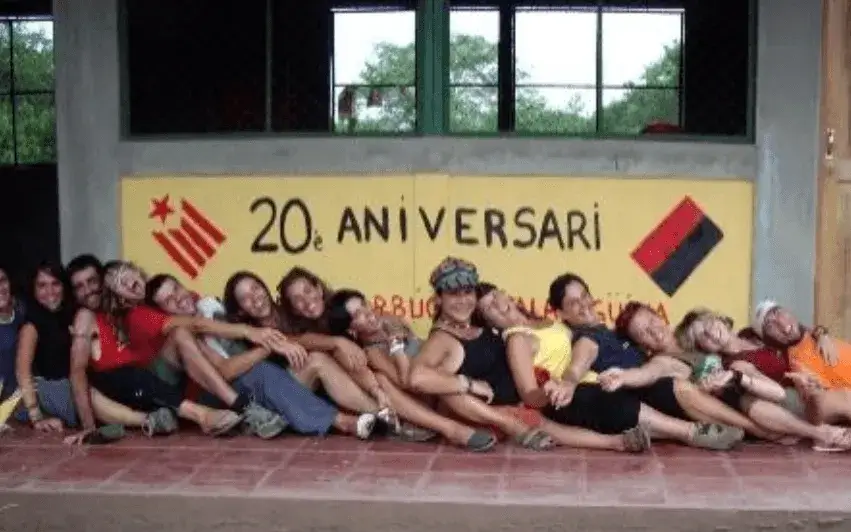
Solidarity Brigade in Palacagüina, in 2006. Source: SOARPAL -
Image
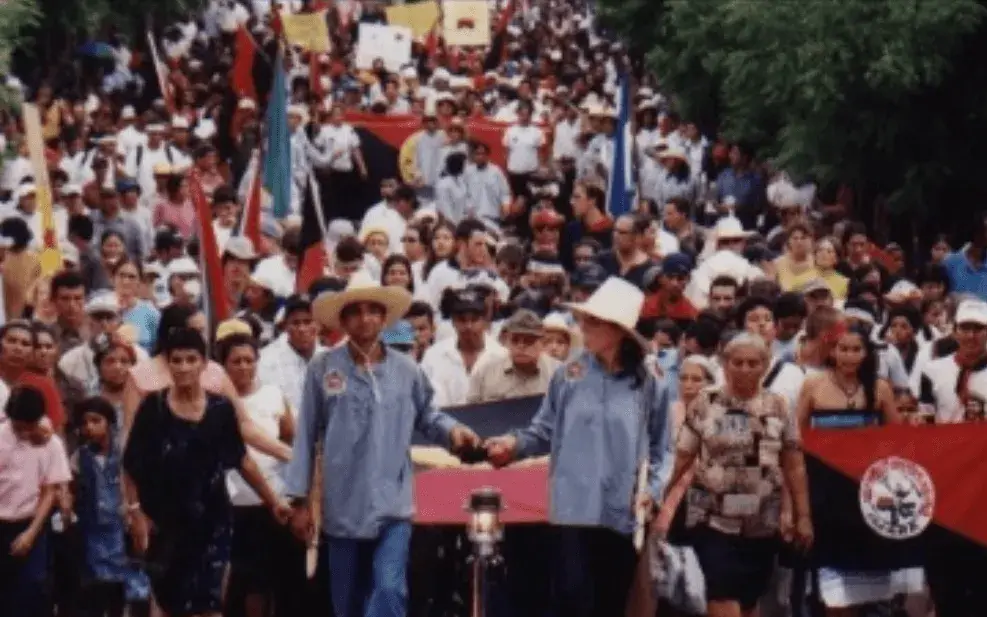
Final event of the literacy campaign in Palacagüina. Source: SOARPAL
Jaume Soler and Dolors Horta review the history of SOARPAL and the forty years of a twinning built through projects, brigades and personal bonds.
Arbúcies and Palacagüina are two towns separated by thousands of kilometres, but united since 1986 by a twinning that has gone far beyond cooperation understood as one-off aid. This has been thanks to SOARPAL, an organisation from Arbúcies that has kept this bond alive through social and educational projects, solidarity brigades and a two-way relationship between Catalonia and Nicaragua.
This 2026, the bond reaches forty years, and SOARPAL will commemorate it on 23 May with a gathering of brigadistas, an exhibition, the screening of a video about the projects promoted in Palacagüina and a community lunch in Arbúcies.
We speak about it with Jaume Soler and Dolors Horta. Soler is a historic activist in solidarity and cooperation, was the first democratic mayor of Arbúcies after Francoism, one of the promoters of the Fons Català de Cooperació al Desenvolupament and president of SOARPAL. Together with Horta, also involved in the organisation, they review the forty years of a twinning born in the middle of the war in Nicaragua and built with a very clear underlying idea: “two different peoples, from different worlds, who come together to contribute to a fairer, freer and more supportive world”.
What is SOARPAL and what role does it play within the twinning between Arbúcies and Palacagüina?
Jaume Soler (J.S.): SOARPAL was formally born in 1994, out of the involvement of Arbúcies’ civil society with the twinning that had been signed in 1986. The twinning was initially created at an institutional level, between town councils, but very soon there was a lot of popular and grassroots social involvement. It quickly became clear that this could not be only a structure coordinated by or dependent on the Town Council, but that it had to have a life of its own. That is why the NGO was created.
This relationship has gone through several stages.
J.S.: During a first stage, until 2003, the Town Council’s line of work coincided with and complemented the twinning, and SOARPAL took on certain functions within it, but without ever replacing the institutional role of the Town Council. Later, because of political changes, the town councils, especially the current ones, in recent years have practically stopped exercising their function. They have never adopted an agreement to cancel the twinning, but they have directly abandoned the obligations they used to have, such as making financial contributions for twinning projects.
What has this meant for SOARPAL?
J.S.: This has meant that SOARPAL has had to take on more and more weight within the twinning. At the moment, it is the one that carries its voice in Catalonia and acts as interlocutor with the Town Council of Palacagüina, which does remain active, and with FUNDARPAL, the foundation that acts as counterpart in Nicaragua. Therefore, SOARPAL is a legalised and active NGO that, today, is the most active actor within the framework of the twinning.
How was the bond between Arbúcies and Palacagüina born, in the middle of the war in Nicaragua and at a time when democratic municipalism was only just beginning to make its way in Catalonia?
J.S.: There is one part of ideological content and another of pure anecdote. Nicaragua was living through a situation of aggression, in the middle of war, but at the same time it represented a new and fresh experience, with its own social and revolutionary model. In 1984, two people from Arbúcies Town Council registered as observers for the first democratic elections in Nicaragua, held in the middle of the war. From there, through groups such as the Casa de Nicaragua, a first contact with the country was opened. That was, in a way, the basis.
Even so, the bond with Palacagüina was born almost by chance.
J.S.: It was an anecdote, like so many others. A couple of lawyers from the Human Rights Commission of the Barcelona Bar Association travelled to Nicaragua and came into contact with the Nicaraguan singer Carlos Mejía Godoy. They accompanied him to a concert in Palacagüina and, afterwards, the mayor of the municipality said to him: “Man, find me a twinning over there.” And they left with that assignment.
Why did they focus on Arbúcies?
J.S.: These lawyers knew Arbúcies Town Council because it had adopted a very clear agreement against what was known as the Corcuera Law, the anti-terrorism law of that time. They thought that if the Town Council had that sensitivity, perhaps it would also be interested in moving forward with a twinning with Palacagüina.
No sooner said than done.
J.S.: Yes, they got in touch with us, they came to see us and we accepted the proposal. On 30 July 1986 the twinning agreement was approved and a first financial contribution of 1,500 dollars was made. It did not come from the municipal budget, but from the small contributions that the councillors of the governing team received for their part-time dedication.
Dolors Horta (D.H.): What really happened is that Jaume, who was mayor, forced the councillors to make that contribution.
J.S.: That is how it was. And in September of that same year, Joan Surroca, a secondary school teacher and pedagogue very closely linked to these issues, and I myself travelled to Palacagüina. He accompanied me on that first trip and on 4 September we signed the twinning, which this year turns forty years old.
Which projects do you think best explain the spirit of the twinning and the work done in Palacagüina?
J.S.: First of all, it must be clarified that we do not choose or propose the projects. This is done by the Town Council of Palacagüina and FUNDARPAL. They always respond to a specific need and to a prior reflection by the people there. At the beginning, in the middle of the war, they were emergency actions, to plug gaps. Later, at many moments, the work has been to accompany and reinforce the investments and social projects of the Sandinista government and the Town Council.
Each stage has had its own needs.
J.S.: In the nineties, for example, when Sandinismo lost the elections, the twinning commission of Palacagüina had to be strengthened, and in 1997 it became FUNDARPAL. A premises was bought and adapted so that it could have autonomy and work normally. With few resources and at such a distance, there was not always prior strategic planning. At the beginning, above all, it was about responding to what Palacagüina needed at that moment.
You have always insisted that it is a two-way relationship. What has Palacagüina brought to Arbúcies?
J.S.: Palacagüina has allowed many people from Arbúcies and Catalonia to know the reality of a country of the South. We are talking about 282 registered people, who have taken part in the 39 brigades that have been carried out. And they did not go there because they happened to end up there by chance or to do exotic tourism, but voluntarily, making an effort and paying for their own trip, to live together, share, collaborate and work on the projects.
This has translated into a whole series of lessons.
J.S.: Through these people, the way of life and culture of Palacagüina have reached here. Many brigadistas later became disseminators and promoters of the twinning, and in some cases even helped create new ones. It has been a real exchange, with a shared way of understanding politics in favour of the majorities, each from their own reality in the North and the South.
D.H.: It is important to add that we are talking about 282 nominal brigadistas, but some have gone two and three times. That says a lot about the interest and what going to Palacagüina entails. Also about the strength of the exchange, because the brigadistas lived with families and shared the day-to-day life of the town.
How did the brigades work and what was the arrival in Palacagüina like?
D.H.: First we did a training session here, lasting two days, to explain the situation in Nicaragua and Palacagüina. In the early years we also worked a lot on the health side and, above all, on the values and respect one must have when going to a country of the South, culturally very different. Once there, the brigadistas stayed with families in Palacagüina, who hosted one or two of them. They made a minimal financial contribution for the stay, which included sleeping, breakfast and dinner. It was a small contribution, but it was also part of the exchange.
J.S.: Couples from there and here have also been born from this relationship. There are ten or twelve mixed marriages and children whom we call “cataniques”, born from this mixture of skin and solidarity. But, above all, there was an underlying coincidence: the brigadista is not asked what they think, but rather to accept, voluntarily, a relationship based on respect and on the way of operating proposed by SOARPAL. It is about sharing, each from their own reality, the will to serve the majority of the people and to collaborate in the growth of a country with criteria of social justice and solidarity.
How have you seen Nicaragua evolve over these forty years of twinning?
J.S.: Nicaragua has gone through many stages. First, the war, which ended in 1990. Then, a stage in which there was an attempt to dismantle that State structure, still very small, that the Sandinista Front had begun to build between 1979 and 1990: public services, education, health, tools so that people could live a little better. Sandinismo spent sixteen years in opposition, after losing three consecutive elections, and opted for a policy of resistance that Daniel Ortega defined as “governing from below”.
With the return of Sandinismo, the situation changed.
J.S.: Yes, from the electoral victory of 2007 onwards, this model has been implemented slowly, but in a significant way. According to our experience on the ground, Nicaragua has advanced a great deal in public services: free education at all levels, meals in primary school in areas with difficulties, major investments in hospitals, roads and communications. Poverty has also been reduced and progress has been made in productive diversification. All this suffered a very hard blow in 2018, with what we understand as an attempted coup d’état, but now the country is recovering and public services continue to function.
D.H.: We can personally confirm this about services and infrastructure, because Jaume and I travelled there in 2024 and 2025. I had not been there for many years and I found a brutal difference.
In these years, the context of international cooperation has also changed a lot.
D.H.: Yes, at the time, everyone talked about 0.7%, but many town councils have been lowering this commitment until leaving it at a minimum or making it disappear. Between demotivation, more individualistic values and the lack of institutional commitment, there has been a considerable drop.
J.S.: It must be remembered that 0.7% was the horizon of the campaign launched by Justice and Peace. In Catalonia, practically no town council reached it. In Arbúcies, yes.
This drop in cooperation has also had concrete consequences.
J.S.: Now we have serious problems with the brigades: last year only one person went and this year, for the moment, there will be none. First the coup d’état cut it off, then Covid came and, finally, there has been a generational change. I do not say this as a criticism of young people, because it is normal and inevitable, but that excitement about living and sharing an experience like the one in Nicaragua has changed a lot. There were years when we organised brigades in July and August. Now, despite doing the same outreach, we have practically been left at zero.
Solidarity twinnings have been losing strength over the years.
J.S.: They have not only lost strength. In the case of Nicaragua, in Catalonia there came to be 32 twinned town councils, and the Catalan Fund was an important tool to promote them. In fact, one of its strategic lines was precisely twinnings. Formally, I think none has been cancelled. But in practical force, right now, three remain: Begues, Girona, linked to Nicaragua’s Atlantic coast, and Arbúcies. Afterwards, there may be some occasional initiative or some person who, on a more personal basis, still does something.
Why do you think this has happened?
J.S.: Because of the evolution of society, because Nicaragua stopped being fashionable and, above all, because civil society has gradually demobilised. Many twinnings were not born only from the will of politicians, but from commissions of brigadistas who pushed and demanded commitment from town councils. When that falls, the twinning remains on the table, but nobody says they are cutting it off; it is simply left to die in a corner.
The situation of international organisations in Nicaragua has generated criticism.
D.H.: Many organisations have criticised the government of Nicaragua because it withdrew their legal personality. But it must be said that the government approved a law to regulate organisations which, in our view, is not very different from the one we have here: renew the board, present accounts and keep documentation up to date. Many associations working in Nicaragua were not legalised or did not present accounts. They functioned through pure voluntarism, but when the government struck them off, the criticism came.
J.S.: There is another issue that has weighed heavily: the feminist debate, especially because in Nicaragua there is no right to abortion. Because of its Christian philosophy, more of religious practice than of belief, the political conditions to legalise it have never existed. This has led a feminist sector, also in Catalonia and in other places in Europe, to interpret that if the Sandinista Front has not approved it, it is because it carries out anti-feminist politics. And here a very strong conflict has opened up.
D.H.: In my case, I have to say that this is an issue I also question and that I find hard to swallow.
J.S.: This also shows that the twinning is not a story of roses and sunshine. It has all the contradictions that humanity has and that international reality imposes. But if it remains alive, it is because there are people who know, live and share this reality.





Add new comment