-
Image

Inspired by the experience of solidarity between Barcelona and Sarajevo, the NGO District 11 – City to City promotes cooperation between cities in contexts of war and post-conflict. Source: District 11 – City to City.
Inspired by the experience of solidarity between Barcelona and Sarajevo, the NGO District 11 – City to City promotes cooperation between cities in contexts of war and post-conflict.
The boldness of mayor Pasqual Maragall transformed a response of solidarity into a singular and pioneering international cooperation initiative. In the midst of the Balkan war, faced with the brutal siege of Sarajevo, Barcelona did not limit itself to sending humanitarian aid; it decided to become involved in rebuilding the city and even came to consider it, administratively, as its eleventh district.
Manel Vila, a renowned expert in international cooperation, played a key role in the conception and implementation of that imaginative formula. He was responsible for humanitarian aid and manager of District 11 between 1992 and 1999. That model made it possible to channel resources and overcome bureaucratic obstacles to rebuild part of Sarajevo’s Olympic Village — the pride of the capital of Bosnia and Herzegovina — and other key infrastructures after the Dayton Accords. It also opened up a new way of understanding international cooperation, based on direct relations between local administrations and on the complicity between cities that share challenges and services.
As a result of that experience, Manel Vila later created District 11 – City to City, an NGO that works to keep alive the lessons learned from that initiative and from cooperation between cities, putting them at the service of new scenarios of conflict and reconstruction. Today, this model has been reactivated with Palestine — Vila is the president of the Advisory Committee of District 11, Cities of Palestine — with the aim of strengthening ties between municipalities and promoting international solidarity from the local level.
Let’s start by looking back. How was the District 11 project born?
The District 11 project was born in 1992, while Barcelona was preparing for the Olympic Games, at the same time as the war in the Balkans and the siege of Sarajevo, which had hosted the Olympic Games in 1984. At that time Sarajevo was suffering an especially cruel siege, often described as medieval. From July 1992 onwards, the city was left without water, electricity, gas or telephone service, and people could not even bury their dead outside the urban area, so many ended up being buried in city parks.
And the city asked for help.
In that context, amid a war of alliances and interests in which Slobodan Milošević and Franjo Tuđman had divided up the territory but had forgotten Sarajevo, the capital of Bosnia and Herzegovina sent out an SOS calling for international solidarity. Faced with the silence and the limited reaction of the international community, mayor Pasqual Maragall responded to that call.
In what way?
First, by establishing a bridge of solidarity between Barcelona and Sarajevo during the war, sending several convoys of humanitarian aid. Then, once the conflict ended with the Dayton Accords, Barcelona committed itself to rebuilding Sarajevo’s Olympic Village and Olympic facilities, which were the pride of the city. To facilitate all the administrative procedures, Pasqual Maragall came up with the idea of configuring Sarajevo as if it were another district of Barcelona — which has ten — and that is how District 11 was born.
From the perspective of international cooperation, what did that initiative represent?
It was a pioneering initiative because until then nothing like it had ever been done. International cooperation had mainly been understood through the 0.7% aid commitment and through subsidies for NGOs to develop projects abroad. That experience opened up another path: direct cooperation, from city to city, which over the years has also been adopted by administrations committed to this field.
Why does cooperation between cities work so well?
Because beyond Catalan, Spanish, English or French, cities speak the same language, and that makes cooperation work. We realized we understood each other when talking about very concrete issues: waste management, water purification, cemeteries, public services… It is a shared, practical language that makes it easier to reach agreements and work together.
Was the initiative well received everywhere?
At first, this direct cooperation generated surprise, as often happens when something shakes the comfort zone and the status quo: “What is this that Mayor Maragall has just invented?” more than one person asked. But over time, the idea of working city to city has gained ground and has become established as an innovative experience, especially because it addresses aspects that more traditional cooperation often does not consider.
This initiative led in 2012 to the creation of the NGO District 11 – City to City. With what objective?
We created the NGO to prevent the District 11 experience — launched by Pasqual Maragall and continued by mayors Clos and Hereu — from fading over time. We were concerned that with political changes or new institutional priorities, the model might return to one based solely on calls for NGO projects and lose direct city-to-city cooperation. The objective was to preserve that legacy and keep the model alive.
So that city-to-city model had a value worth preserving.
For a group of people who had been involved in that experience, the city-to-city model had a very clear singularity. That is why we created the association: to preserve the legacy of everything that had been done and, at the same time, to continue pushing wherever possible, contributing the accumulated experience, the agreements and above all the contacts, which are key in this type of cooperation. With this trajectory we have also been able to contribute in contexts of conflict or conflict prevention, and other cities have gradually joined in.
How was that cooperation structured?
Following the experience in Bosnia, we promoted an initiative under the umbrella of the Council of Europe, through the Local Democracy Agencies (LDAs), which served to formalize agreements between civil society and administrations from conflict-affected territories and from other places. Today the LDAs are still operating and, for example, in Ukraine they have played a very important role in supporting municipalities that are going through extremely difficult times. This is the idea we have tried to keep alive through the District 11 – City to City association.
And how did the idea move from that experience to Palestine?
For some years we tried to get the Barcelona City Council, under the previous administration, to take on a stronger commitment with a city in Ukraine, but it did not succeed. During the current term, however, the new administration and mayor Jaume Collboni understood that the twinning with Gaza City and the collaboration agreements Barcelona has had for years with Ramallah and Bethlehem could give shape to the initiative. We contributed our experience so that District 11 could once again operate with the cities of Palestine.
Do you see parallels between the experience of Sarajevo and the current situation in Gaza?
I do not see them in terms of the conflict itself, because every war has its own singularity. The parallel, in any case, lies in the way of working: there is a stable relationship between the municipal technical teams of Gaza City, Ramallah and Bethlehem and those of Barcelona, which allows for continuous cooperation. And when Barcelona moves on the international stage, other European cities that were already paying attention tend to join in, raise their voices and take a step forward. That said, I insist: what was done in Sarajevo has nothing to do with what is being done today in Gaza City, nor with other municipal cooperation experiences such as those in Maputo or Medellín.
What are the main difficulties of promoting a cooperation initiative in a context of war or post-conflict?
Today the main difficulty in Palestine is that the conflict has not ended and there is no clear prospect that it will be resolved on a defined timeline. What has been signed regarding Gaza is not a peace agreement. In the West Bank there is a situation of total occupation and the population has no freedom of movement, while violence continues in everyday life. We may not be talking about the bombings and attacks of the last three years, but there are violent acts, killings and deaths every month and every week.
Under what conditions is cooperation being attempted on the ground?
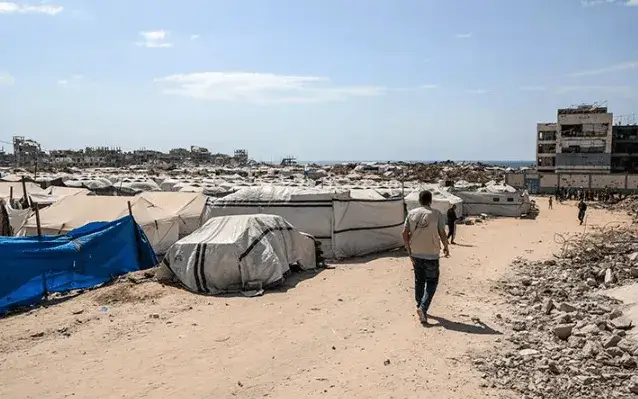
In Gaza City, people with illnesses often cannot leave to receive treatment in hospitals, and those living in refugee camps also lack freedom of movement. And it is not only Gaza: in the West Bank and its villages the situation is the same or even worse, and it tightens every day until it resembles a vast concentration camp. A recent decision by the Israeli government, which considers the West Bank “occupiable territory”, could lead within months or a year to a completely unsustainable situation.
The current context, however, is very different from that of the 1990s.
Back then, with the Dayton Accords, we were able to begin a reconstruction program. Now there is no peace agreement and no end to the conflict, and we have to work under conditions in which the occupying government does not make things easier.
You have closely followed the evolution of international cooperation for more than thirty years. How has it changed during that time?
It has changed a lot — enormously. Thirty years ago, to demand the 0.7% commitment we had to camp out and apply pressure so that administrations would understand that what happens here is related to what happens thousands of kilometers away. Today we live in a completely globalized world and that no longer needs to be explained as much.
Moreover, we know that if we want to avoid problems we must also work on development in Africa, support Latin America or intervene in places where there is a latent conflict. In that sense, we now have to “break less stone” than before. However, inequality in the world has increased: fewer and fewer people accumulate more and more wealth, while more and more people have less. And in the long run that constantly fuels new conflicts.
It is one of the main challenges facing the world of cooperation.
There are many challenges, and they have been growing. NGOs working decades ago did not focus on climate change, and today we already see that, depending on the context, it is not enough to address a single issue such as literacy, education or hunger. Now, when we talk about development and global justice, we have to work on many more fronts at the same time.




Add new comment