
Aliou Diallo: “There is a tendency to blame the most vulnerable instead of looking upwards”
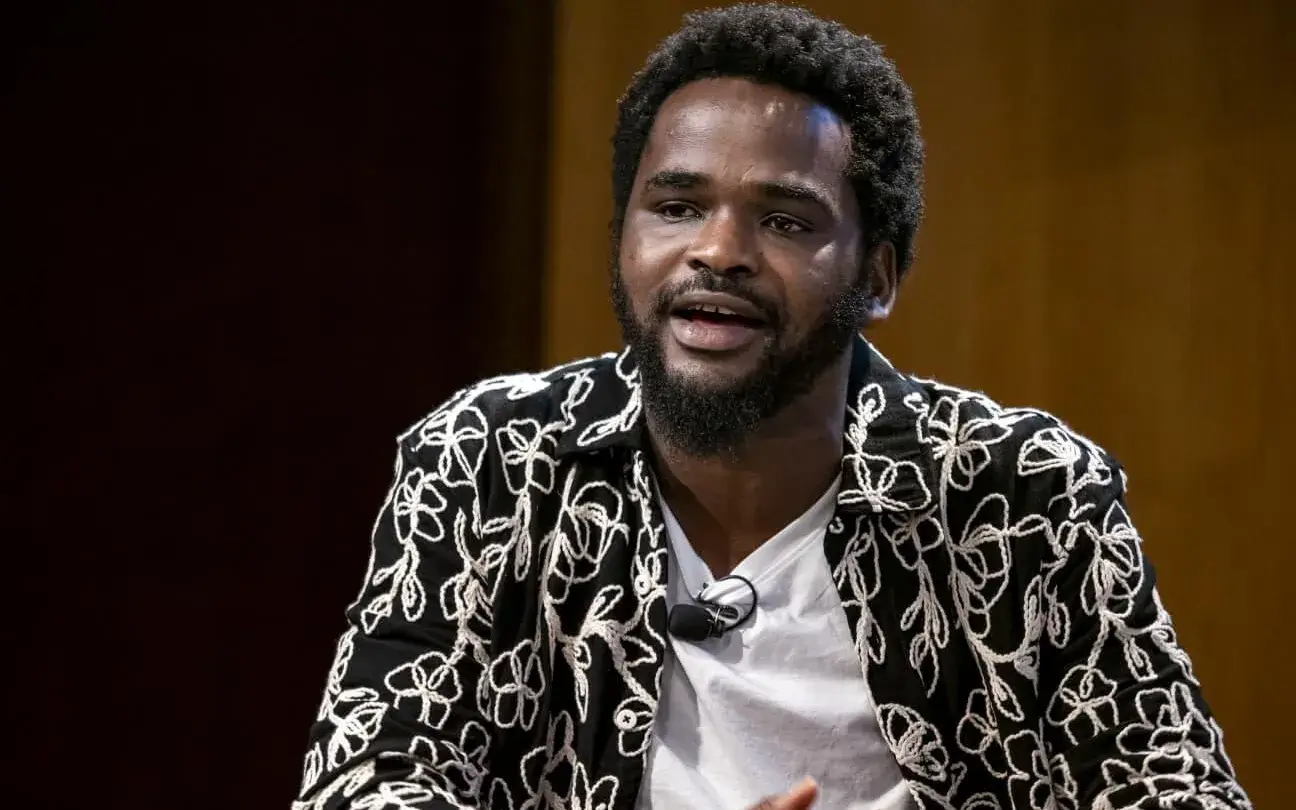
We speak with one of the members of Cacau & Negritud, a collective from the Girona counties that fights against racism —which manifests itself in practices such as blackface— and the criminalisation of migrant people.
Cacau & Negritud is a collective born in Girona that works from within the Black community to combat structural racism and hate speech that spreads through the streets, institutions and social networks. They do so through grassroots organising, with spaces for empowerment and mutual support, but also by placing issues such as blackface in the Girona parade at the centre of public debate.
At a time of rising far-right movements, the collective stresses the need to put racism at the centre and to point out the political and economic responsibilities that fuel these narratives. We speak with Aliou Diallo, one of its members, who, among other things, explains why they continue to denounce blackface in the Girona parade, a practice that, despite growing criticism, once again makes the news year after year.
How did the Cacau & Negritud collective come about?
Cacau & Negritud emerged almost spontaneously. It was born at the University of Girona, within the framework of debates and seminars with Political Science students —mostly women— who met to talk about racism, segregation and the social exclusion suffered by people affected by racism. We soon realised that it made no sense for these conversations to remain only within the university, but that they had to reach the streets. From there came the proposal to create a reading club with decolonial and anti-racist texts and, from that space, the collective was born.
Which has gone far beyond a reading club.
It has become a space of empowerment to decolonise the minds of many people from the Black community itself, who sometimes hold harmful views about their own Blackness. Therefore, Cacau & Negritud is a group of Black people from across the Girona counties, who share the fact that we are Black African people who also feel Afro-Catalan, and from here we work to defend our rights and combat racism.
What tools do you use as a collective to dismantle hate speech and create these spaces of community?
An important part of Cacau & Negritud is intracommunity work that often goes unseen. Within the Black community we detect a gap between our reality, as second- and third-generation young people, and that of our fathers and mothers, who very often experience racism from a position of resignation, as a reality that cannot be fought and in the face of which the best option is to try to endure it and not expect much change.
You, on the other hand, are committed to creating dynamics of resistance.
That is why one of the things we work on is approaching our elders with the idea that we have to go further and stop giving certain spaces and political forces the opportunity to instrumentalise us. We often see, especially during election campaigns, parties that go directly to mosques and use spiritual centres to reach the Black community, and this ends up generating harmful leaderships. Many times, these religious leaders have a very ageist view of reality and are far removed from what we experience.
You work for the empowerment of the community.
Yes, the main objective of Cacau & Negritud is to empower Black people so that we embrace our Blackness. At the same time, we create spaces that are often therapeutic, where you can feel safe to talk about the racism you experience or about anything else that concerns you and that, in spaces with white people, you might not dare to explain or might not feel as comfortable doing so.
What strategies do you use to do all this?
Based on this internal work within the community, we also draw up strategic lines to place very specific and concrete issues on the agenda. In recent years, for example, we have denounced the issue of the Girona parade and blackface; and now, among other things, we are addressing the difficulties faced by people without Spanish nationality in doing internships in medical centres. Our main work is within the community and, from there, our relationship with the outside translates into placing these issues on the political agenda to raise awareness about the need to fight racism.
In a context of rising racism and far-right movements, where do you currently most strongly detect hate speech? Are we talking about social networks, the street, the media…?
Fortunately, the tension and the scale of hate speech that we see on social networks often does not translate to the street, because if it did, we would not be here. That said, there is a certain current linked to a worldview based on feeling strong against those who are more vulnerable. In this paradigm, people of foreign origin are in the crosshairs and, within this group, especially Black people and people of Maghrebi origin.
And how do you deal with this reality?
We try to approach it from an analytical and constructive perspective. We believe that what has happened as a society is that many social and economic crises have been chained together without being resolved, and that political neglect has generated a great deal of frustration among people who had trusted governments and parties to improve their lives. If we talk, for example, about the housing emergency, today it is very likely that if you ask anyone on the street about the causes of this situation, they will answer that there are too many migrant people or too many occupations. However, the reality is that none of these things explains at all the housing emergency we are experiencing.
Unfortunately, these messages have taken root.
There is a tendency to blame the most vulnerable instead of looking upwards and holding power and governments to account for budget cuts and underfunding of public and social services since the 2008 crisis, or for the fact that wealthy people pay less and less in taxes. This is the paradigm: economic and media elites are managing to get vulnerable people to point the finger at others who are in an even worse situation than theirs. Faced with this, there is only the ant-like work.
The focus is being misplaced.
Exactly. In this sense, we will never sit down to negotiate racism with a real estate company, because when we denounce housing racism, what they respond is that it is not a matter of racism, but merely of economic capacity.
And one thing is connected to the other.
That is why we are adopting a more belligerent position towards hate speech, but always with the intention of placing racism at the centre. The problem is that often people only talk about tensions in neighbourhoods, which we acknowledge can exist when demography and social relations change significantly over five or ten years. In this sense, we understand that there are issues that, as a community, we must face and work on, but always from a perspective that takes racism and its historical impact on our reality into account.
For example, as you said, in the housing situation.
Exactly. If we want to talk about the housing emergency, housing racism or residential exclusion, we have to talk about racism. In the eyes of many landlords or real estate agencies, a Black person who walks through the door is automatically associated with poverty and precariousness. There is a tendency to make us feel inferior and to always see us through this lens of lack. This component, which is intrinsic to residential exclusion, must be put on the table.
It is essential to recognise that racism exists and is very present.
That is why we also fight against this very European perspective of managing cultural differences through the paradigm of multiculturalism, which claims that if we see each other on the street and share ‘world food days’ at the parents’ association, racism will end. The problem with this approach is that it does not recognise that racism exists and that it places some people in a position of superiority while oppressing others.
A change of perspective is needed.
We embrace an anti-racist perspective, that is, placing racism at the centre, recognising it and accepting that it continues to respond to patterns that still benefit some people today while making others more vulnerable. From there, we seek solutions by placing at the centre the opinion and perspective of those who suffer it, because there is no better prescriber than the affected person. Unfortunately, in this case, those who most often get caught in this are Black African people.
Language is also very important, and racism is very often not spoken about openly.
Obviously, because language shapes reality. If in a building it is presented as a problem that there is a Black African family with two, three, four or five children going up and down the stairs and making noise, you are immediately placed in the crosshairs and nothing is explained about that family’s reality.
Which is very often marked by precariousness.
If we look, for example, at the AROPE rate, the European index of risk of poverty and social exclusion, in 2024 around 17% of people with Spanish nationality living in Catalonia were at risk, while in the case of people without Spanish nationality the figure rises to approximately 45%, almost triple. This explains what happens in many densely populated neighbourhoods, where many people live who often have no way of reconciling work, personal and family life.
Therefore, perhaps the focus should first be on improving these figures.
Yes, and this gives rise to another very recurrent discourse when talking about coexistence and security, which claims that people of foreign origin do not integrate. Faced with this, we argue that no one integrates if they cannot make it to the end of the month, whether they are called Jordi, Mamadou, Fàtima or Maria. No one has the energy to participate in the neighbourhood association or the local festival if they do not know what they will eat in a week’s time or where they will live in a month. Therefore, guaranteeing basic needs is key both to preventing hate speech and to fostering coexistence.
On social networks, hate speech spreads very easily. How can these narratives be reversed?
The balance here is difficult to find. We now have social networks where discourses that five or ten years ago were marginal or outright ridiculous have gained centrality. No one dared to openly say they were anti-feminist or racist, and today these people find support. Algorithms amplify this content because there is economic profit behind it and, from there, the bubble ceases to be only digital and increasingly becomes reality on the streets.
And what do you think explains this normalisation?
The normalisation of these discourses is linked to political and economic interests. There is a clear interest in people not pointing to those in power as responsible, but instead looking towards those who are more weakened. And if this common enemy is a migrant person who has no right to vote and less capacity to defend themselves, it is even more useful to them.
The issue of rights is another central problem.
If to all this we add that we have an immigration law that allows for the direct expulsion of people without Spanish nationality convicted of public disorder or assault against authority —charges that under the gag law are often very easy to justify in a police report—, we see how all the circles are closed. On the one hand, you suffer racial discrimination and job insecurity, and on the other, you are sent the message that you cannot complain, because the issue of public disorder basically means this: do not protest. Faced with this, our commitment is ant-like work, especially at the municipal level, with the clear understanding that people of foreign origin have come to stay and that this will only increase.
In this sense, perhaps the narrative that is often imposed about migration should also be questioned.
Of course. If they ask us why we are here, it is because after 400 years of plundering our lands and our human and material resources, the wealth that exists in Europe is explained by the poverty suffered by our ancestors and that our families in the country of origin still experience today. Therefore, if we come here, it is because we come to seek what is also legitimately ours. Globalisation is nothing more than a continuation of colonisation, because nothing has ever been repaired.
Let’s return to the issue of political and institutional influence.
In the spaces where there are more people of foreign origin, there is also more media focus and more hate speech, but it must also be taken into account that more and more people are able to vote. One of the things we are clear about is that we must activate this vote. We are not naive, or we must stop being so, and think that a party will defend anti-racism just because it forms part of the human rights package. No party, or very few, act from this perspective.
Electoral gain prevails.
Electoral gain also means economic gain and power. That is why the only path we see is to organise ourselves: first in the streets, breaking dynamics that make us even more socially and politically vulnerable, and then articulating our own people. The minority that has the right to vote, by exercising it and voting for anti-fascist parties; and those who do not yet have it, by accompanying them and helping them with all bureaucratic procedures so that they can eventually exercise these rights as well.
One example of racism you denounce is blackface in the Girona parade.
It is racism and, once again, it has a lot to do with electoral gain. In the case of Girona, we are talking about a government led by Guanyem, which before the 2023 elections publicly condemned blackface in the parade. What happened? They reached power, formed a coalition with parties that defend racist practices, such as Junts per Catalunya or even parts of Esquerra, and from there there has been resistance and justification of this practice that is even insulting.
What do you attribute this resistance to?
Here, too, it has a lot to do with the nature of the city of Girona, where an entity like Manaies, which receives more than 60,000 euros annually to organise, among other things, the parade, holds a great deal of power and has a direct agreement with the City Council. What we do not understand is why this agreement does not include, like any administrative contract, a clause respecting human rights. Doing blackface violates the right to equality, the right to non-discrimination and the right to dignity, and also violates children’s rights on such a special day in the calendar.
What does continuing with this practice imply?
The result of maintaining blackface is basically that Black children and young people see Blackness as something negative and reject this label. If, in addition, the Girona City Council pays for a performance that ridicules Blackness to parade through the streets every 5 January, all of this becomes even more difficult to reverse.
You say it could be solved very easily.
We are talking about the fact that, with a single phone call from the City Council to Manaies demanding compliance with human rights, this would end. We are not asking them to fill Baltasar’s entire entourage with eighty Black people; that is irrelevant to us. The only thing we ask is that they do not paint white people to portray Black people. They can paint them whatever colour they want or have the entire entourage be white people —we do not care. But despite this, we encounter these difficulties.
Collectives like yours or SOS Racisme have been fined for protesting against these practices.
It is a dynamic of intimidation. Your rights are being violated and, on top of that, you are sent the message not to shout too loudly, because if you expose what is happening, you will be placed in the media crosshairs. To prevent you from doing so, you are fined and, if possible, this is done in a humiliating way. In the case of last year’s parade, there were fewer than ten of us, a spontaneous gathering born from the feeling that we were being excluded from a family space in the city. The Mossos arrived, moved us aside, confiscated all the material and, a month later, we received the police report with the fine and a narrative that completely distorted reality.




Add new comment