
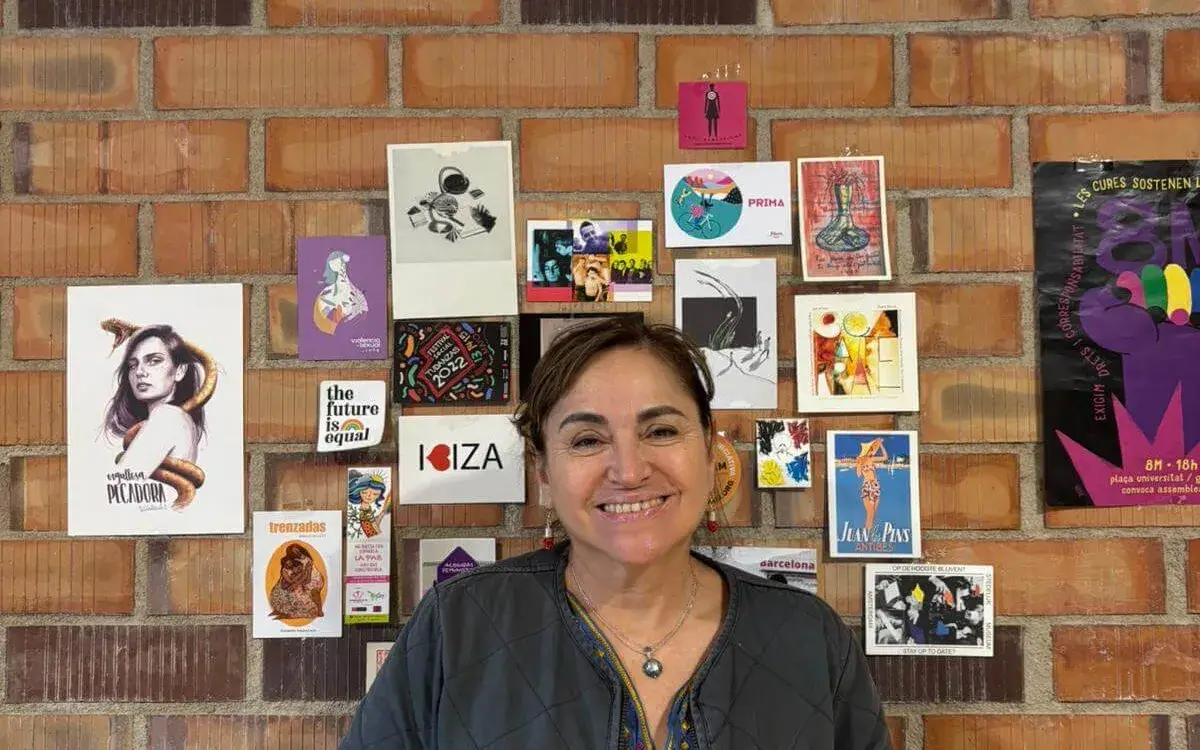
We spoke with Diana Damián, Director of Training and Capacity Building at FOCA, about the current situation of migrant women at the Mexico–Guatemala border and the growing violence they face along migration routes.
This interview was conducted in the context of the visit to Barcelona of two prominent human rights defenders working in migration contexts. From 13 to 22 October, the city welcomed Diana Damián, from the organization Formación y Capacitación (FOCA) in Chiapas, Mexico, and Carolina Gutiérrez, from the Red de Gestoras de Derechos and APROSUVI in Huehuetenango, Guatemala. Both play a key role in defending the rights of women and children on the move at the Mexico–Guatemala border. Their presence offered a valuable opportunity to hear directly about their struggles and proposals, to better understand the realities of the border, and to learn from their models of care and reception.
How would you describe the current situation of migrant women at the border between Mexico and Guatemala?
I would describe it as a situation of high vulnerability. Women migrating through the southern border face multiple risks at every step of their journey. On the one hand, there is their health condition when they arrive; on the other, the constant insecurity they face simply because they are women.
This combination of factors also leads to different forms of violence against them, mainly perpetrated by men—whether other migrants, transport workers, members of the communities they pass through, or even the authorities themselves.
FOCA has been working with women on the move for more than two decades. What has changed, and what remains the same in this context?
When we first began this work, the central corridor was more “kind” to women—by that I mean that crossing was somewhat calmer. Over the past ten years, violence has intensified enormously. All migration corridors have become unsafe and are now controlled by organized crime.
Women’s vulnerability is far greater today. After ten or fifteen years, the entire situation at the border has changed. It used to be a border you could cross back and forth; now it is controlled by drug trafficking and organized crime. Yet migration continues—it has not stopped.
In your research and publications, you mention femicidal violence in Chiapas. How do gender-based violence and migration-related violence intersect?
There is no proper follow-up on the femicides of migrant women. Generally, femicides are reported in cases involving women who live or are settled in specific places, and that is when the police intervene.
In the case of migrant women, many simply disappear, and we never hear from them again. They fall outside official records and investigations.
What role does mental health play in the processes of accompaniment and reception of migrant women?
Mental health is a fundamental part of a comprehensive approach. Our model of care explicitly includes mental health, alongside legal and social support. We work with a lawyer, a psychologist, and a social worker who provide care and accompaniment to women.
Mental health is a key factor, although we face many shortcomings, especially when it comes to partnerships with the health sector. In psychiatry, for example, there are very few specialists. Overall, the mental health system fails the entire population—but in the case of migrant women, that failure is even greater. For them, life itself has already fallen deeply short.
What does a “feminist, intersectional reception” mean to you?
It is a very context-specific concept, because here reception is carried out jointly by the State and civil society organizations.
In reality, we often cannot even call it reception. It is more a matter of receiving people. Whether women arrive through civil society organizations or are detained by the National Migration Institute, there is no real reception—what exists is detention. From civil society, we support procedures such as regularization, asylum applications, or reporting violence.
Through institutions, migrant people can access certain services, such as the public health system, which is free. However, many are afraid of being detained. Gradually, word spreads among them, and many come to know that, in most cases, they will not be detained when accessing these services.
What lessons do you think Europe could learn from community-based work in southern Mexico?
Primarily, the work of civil society. Our model of care is more empathetic, closer, and more comprehensive.
Of course, we also have much to learn from the reception models that exist in Europe. But this emphasis on empathy, accompaniment, and sharing that characterizes Mexico and Central America’s relationship with people on the move could be an important contribution to European societies.
How important is it to create international networks between feminist organizations in the Global North and the Global South?
I strongly believe that networks save lives. Networks of women and civil society organizations are what sustain us. In contexts of such extreme insecurity as ours, networks have often been the only way to locate people, to find women—or, in the worst cases, to find their bodies.
Networks always save lives in one way or another. This also includes communication networks. For example, through radio, we produce programs that are broadcast to El Salvador and other territories, where other women listen and learn about their rights—to migrate, or even not to migrate. Networks save lives. This is a lesson we have learned, but also a practice we have built ourselves.




Add new comment