-
Image
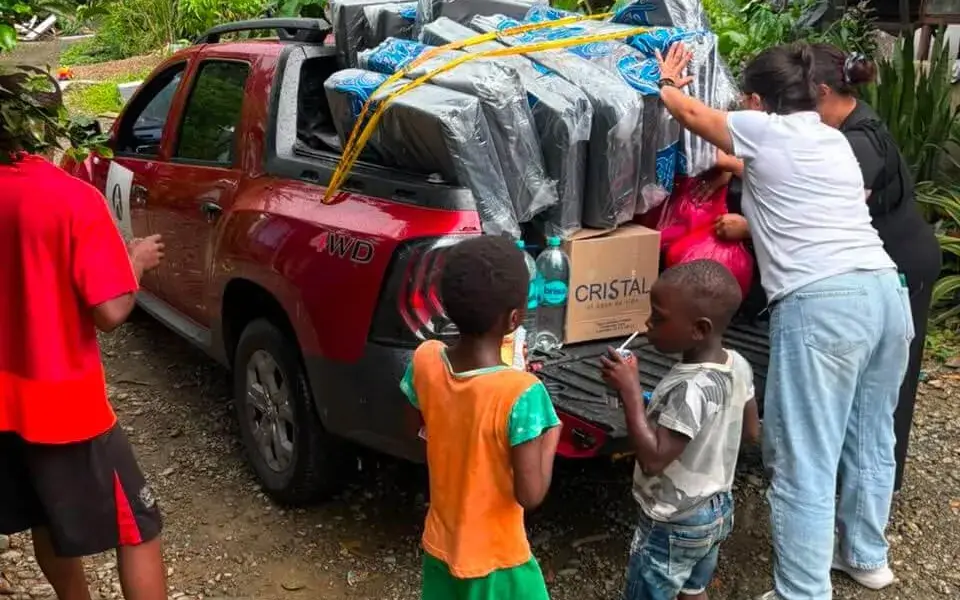
The earthquake in Buenaventura has left 954 homes destroyed and nearly 9,200 damaged, as well as eleven people dead and 476 injured. Source: Bumaro.
Dagua and Bumaro warn that the emergency has worsened long-standing inequalities and call for sustained, effective solidarity from Catalonia.
When the earth shook on 10 August, many families in Buenaventura (Colombia) were already living through another kind of earthquake. Olga Grueso, co-founder of Dagua, an organisation from Girona that has been working for two decades with communities in the Lleras neighbourhood, puts it bluntly: “Before this physical earthquake, people were already suffering from the earthquake of neglect, state corruption, and structural and institutional racism.”
The earthquake has worsened an already difficult situation. In the neighbourhood, many of the families Dagua works with lived in wooden houses built in low-tide areas. Grueso explains that many of these homes have been destroyed or seriously damaged and that many families are temporarily sleeping in tents, in spaces set up at the Piloto school, or in relatives’ homes.
A look at the figures gives an idea of the scale of the impact. According to the Presidency of Colombia’s assessment of 24 August, the earthquake in Buenaventura has left 954 homes destroyed and nearly 9,200 damaged, as well as eleven people dead and 476 injured.
Bumaro association, also linked to Buenaventura and with a presence in Catalonia, explains that, after the first few weeks, the consequences that will go beyond the first phase of the emergency are beginning to emerge. “Now, the concern is no longer only the most immediate emergency, but what will happen to the families who have lost their homes and livelihoods once this first stage is over,” explains Nelson J. Ruiz, president of the organisation.
“What little they had, they have lost”
The fragility of the housing cannot be understood without taking into account the socioeconomic conditions of many families in Buenaventura. “What little they had, they have lost,” Grueso sums up. In this regard, and as she explained in an interview with Xarxanet, Dagua works with households that were already facing economic difficulties, unemployment, and shortcomings in access to services before the earthquake.
Buenaventura is home to one of Colombia’s main ports, but this economic importance does not benefit the population. Quite the opposite: it coexists with deep inequalities. Ruiz believes the earthquake has once again brought this contradiction to the fore. “Poverty here is very evident,” he says, linking it to a sustained lack of investment: “Over these years, the port has mattered, but not the development of the population.”
Low-tide areas and the most precarious housing have been particularly exposed, while many families have little financial room to repair, on their own, the homes that can still be saved. In this sense, the earthquake has not created all these vulnerabilities, but has worsened them and made them more visible.
When aid is not enough
Needs have also evolved as the days have passed. Food remains essential, but Grueso gives an example that shows the limits of aid when it is not adapted to families’ realities. “It is true that a lot of food is arriving and that people have shown great solidarity, but what do they do with that food if they have nowhere to cook it?” she asks.
For this reason, among other actions, Dagua has set up a community kitchen. The organisation now points to housing as the most urgent need: improvised accommodation may solve the problem for the first few days, but it does not provide a stable alternative for those who have lost their homes. At the same time, it has distributed hygiene products, nappies, milk, and other basic items, especially among families with children. “The amount of food pouring in is impressive and, even with all of that, it still does not reach everyone,” Grueso warns.
Bumaro also mobilised from the first days. The organisation collected resources among people connected to Buenaventura and used them for water, medicines, mattresses, sheets, and other essential items. A significant part of the aid, Ruiz explains, was directed to the rural area, where the initial response arrived with much greater difficulty.
Children and adolescents, one of the most vulnerable sectors of the population, are also being hit hard by the consequences of the disaster. The emergency has disrupted the daily lives of thousands of young people. On 20 August, the Defensoría del Pueblo counted 99 affected educational sites and nearly 10,000 students out of class in Buenaventura.
Dagua has continued its psychosocial support workshops with children and young people in Lleras in an attempt to recover “a little normality” amid the loss of homes, the suspension of classes, and uncertainty. Technology does not solve the problem either. “They are trying to do it remotely, but most of them cannot do that either because they do not have the means,” Grueso explains.
A response that comes from below
If there is one factor Dagua and Bumaro both highlight, it is the role of the people of Buenaventura themselves. “The first response came largely from the community itself,” Ruiz says, stressing that residents, shops, businesses, social organisations, and people from Buenaventura living outside the territory mobilised from the very beginning.
Strengthening the community network is one of the key elements in confronting the emergency. In the Lleras neighbourhood, Dagua works jointly with twelve local associations and the community council to identify affected families and decide on priorities. The organisation is carrying out censuses and interviews with a social worker, while maintaining the community kitchen and the spaces for children and young people.
This capacity for organisation, however, cannot replace the responsibility of institutions. Ruiz acknowledges that the public authorities are present and that public-sector staff are making “a great effort”, but he also points out that, “given the scale of the emergency, the response is still falling a little short”. For the president of Bumaro, it is essential that decisions are not made with their backs turned to the territory. “It is essential to listen more to the communities and the professionals who know it,” he argues.
From the emergency to reconstruction
After the first few weeks, Dagua and Bumaro are already looking beyond the most urgent needs, such as food and temporary accommodation. The main concern is what will happen to the families who have lost their homes and, in some cases, also their income or livelihoods.
Dagua has begun to identify the households that will need support to rebuild. The first objective is to rehabilitate the homes of seven particularly vulnerable families, headed by women caring for children and elderly people. After the first few days focused on assessing the damage and covering basic needs, the organisation has launched a specific crowdfunding campaign to finance these reconstruction efforts.
Bumaro is also seeking resources to address this new phase. The organisation has submitted an application to Barcelona City Council, which is still awaiting a decision, to obtain support to rebuild some homes, and has taken part in talks with Girona City Council, together with other Colombian organisations, to explore new avenues for collaboration.
Ruiz points out that they initially also considered sending mattresses, tents, and other materials from Catalonia, but the transport costs, tariffs, and lack of a clear humanitarian channel made this unfeasible. “Right now, what is mainly being recommended is to donate financial resources,” he advises.
The idea is to channel contributions through organisations that know the territory and avoid improvised shipments of material that can make the response more expensive and complicated. Buying directly in Buenaventura also makes it possible to adapt to actual needs and keep resources moving within the local economy. But reconstruction is not only about the material dimension. As the organisations stress, it will also be necessary to restore income, small businesses, and ways of life so that families can once again support themselves independently.
“We work for the future,” Grueso says. And the fear is that the wave of solidarity will fade when media attention does too, as happens with many emergencies. “When this whole media cycle ends, it is forgotten,” she concludes.




Add new comment